Trail status (checked September 2026) — conditions change; confirm with the managing agency before you go.
- Tropical Storm Fred (2021) washed out the bridge, pool and most of Skinny Dip Falls; the walk now ends at an unbridged stream crossing, not a swimming hole. Source: Blue Ridge Parkway / Friends of the MST
- After Hurricane Helene, the Big Creek Trail in the Great Smoky Mountains is open only as far as Mouse Creek Falls; the section beyond, including the route to Walnut Bottom, is closed. Source: National Park Service
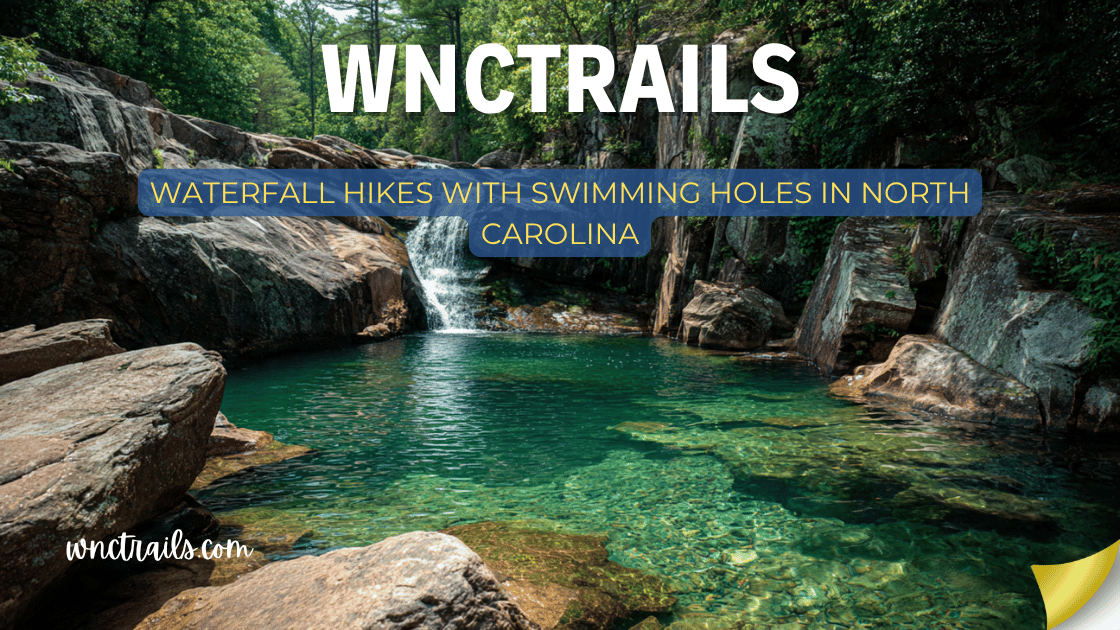
Not every waterfall in Western North Carolina comes with a place to swim, and that’s the part most lists gloss over. You can drive an hour on a gravel forest road expecting a deep, cold pool and find nothing but a rocky spray zone and a “no swimming” sign. This page sticks to the waterfall hikes where a real swimming hole is documented — not just implied by a pretty photo. If you’re planning a hot-weather hike where the payoff is actually getting in the water, this is the shortlist.
Waterfall Hikes With Confirmed Swimming Holes
Western North Carolina has dozens of waterfall hikes, but only a handful are documented as having an actual swimming hole rather than just a scenic overlook or a wading spot. Here are the ones worth building a trip around.
1. Sliding Rock Recreation Area
This is the most straightforward swimming waterfall in the region: a 60-foot natural rock waterslide that dumps you into an 8-to-10-foot-deep pool, a short walk from the parking area. It’s an easy trip in terms of hiking effort, but it’s not a quiet nature walk — there’s a day-use fee, and lifeguards and restrooms operate Memorial Day through Labor Day. Outside that window, or during high water or lightning, the site can close entirely, so this is one where checking current conditions before you drive out actually matters.
2. Glen Falls Trail
Glen Falls is a 0.60-mile trail that passes three separate waterfalls, and the third one is specifically documented as having a family-friendly swimming hole. That makes it one of the few hikes on this list where you get a genuine multi-waterfall experience and a confirmed place to cool off at the end, without a long approach. The trail is short enough that it works as a half-day trip paired with something else in the area.
3. Mouse Creek Falls via Big Creek Trail (Midnight Hole)
This roughly 4-mile round trip in the Big Creek section of Great Smoky Mountains National Park passes Midnight Hole, a well-known swimming hole, on the way to the 45-foot Mouse Creek Falls. It’s a moderate hike, longer than most of the other options here, which keeps crowds a little more manageable than the roadside spots. One important note: after Hurricane Helene, the Big Creek Trail is open only as far as Mouse Creek Falls — the section beyond is closed, so don’t plan on continuing past the falls until that changes.
Worth Knowing About, But Not a Sure Thing
A couple of other trails come up constantly in “swimming hole” searches, and I want to address them honestly rather than pretend they’re not part of the conversation.
Turtleback Falls, reached about half a mile beyond Rainbow Falls in Gorges State Park, is a smaller sliding cascade upstream of Rainbow Falls. The verified trail information doesn’t specify a swimming hole here, so treat it as a scenic stop on the Rainbow Falls hike rather than a guaranteed swim spot, and use your own judgment on the water once you’re there.
Skinny Dip Falls, off the Blue Ridge Parkway near mile marker 417, has a name that promises exactly what people are looking for — and it used to deliver. Tropical Storm Fred washed out the bridge, the deep pool, and most of the falls. Today it’s an unbridged stream crossing, not a swimming destination. I’m including it here specifically so you don’t drive out expecting the old version of this hike.
How We Ranked These
The list above isn’t every waterfall hike in the state — it’s the ones that meet a specific bar. Here’s the reasoning behind the picks.
Documented swimming access. A waterfall photo doesn’t mean a swimming hole. I only included trails where a real pool or designated swim area is part of the verified description, not trails where swimming might be technically possible but isn’t the point of the hike.
Current condition status. Western North Carolina trails have seen real damage from recent storms, and some former swimming spots — like Skinny Dip Falls — no longer function as swimming destinations. I’d rather tell you that upfront than let you find out at the trailhead.
Effort versus payoff. Sliding Rock and Glen Falls require very little hiking for a real swimming reward, which matters if you’re bringing kids or just want a quick cool-off. Mouse Creek Falls asks for more distance but rewards you with a quieter setting inside the national park.
Parking and Trailhead Reality
Sliding Rock has a dedicated parking area, but it fills up fast on hot summer weekends, especially during operating season when lifeguards are on duty — arriving early or on a weekday makes a real difference. Glen Falls has a small trailhead lot that can also fill during peak weekends given how short and accessible the hike is. The Big Creek trailhead for Mouse Creek Falls tends to be less crowded simply because of the longer approach, but it’s still a popular entry point into the Smokies, and parking is limited rather than expansive. None of these have overflow lots you can count on, so build in a buffer if you’re set on a specific arrival time.
Seasonal Notes and Water Conditions
Swimming holes are a warm-weather draw, but water levels and safety change through the year regardless of air temperature. Sliding Rock specifically can close for high water or lightning even during its official season, so a forecast that looks fine in town doesn’t guarantee the site is open when you arrive. Midnight Hole and other creek-fed pools run cold even in summer and get significantly higher and faster after rain — a pool that’s calm one week can have real current the next. Fall brings leaf-season crowds to nearly every waterfall access point in the region, which can make parking and trail traffic worse even at spots that aren’t primarily known as scenic drives. If your goal is actually getting in the water rather than photographing color, aim for mid-summer on a weekday when you can.
Access Notes and What to Expect
A few practical points that don’t fit neatly elsewhere. Sliding Rock charges a day-use fee and only staffs lifeguards and restrooms seasonally — outside that window you’re on your own for safety, so check current operating status before counting on facilities being open. Glen Falls’ swimming hole is at the third and furthest waterfall on the trail, so budget time to reach all three rather than turning back after the first view. The Big Creek Trail’s closure beyond Mouse Creek Falls, tied to Hurricane Helene damage, means this is currently an out-and-back to the falls rather than a longer loop or connector hike — plan your mileage accordingly. As with anywhere in this list, conditions on Forest Service and National Park land can shift with storm damage or maintenance, so a quick check before you leave home saves a wasted drive.
Frequently Asked Questions
Which waterfall hike has the best swimming hole in North Carolina?
Among the verified trails, Sliding Rock has the most established swimming setup, with a defined pool, seasonal lifeguards, and facilities. Glen Falls and Midnight Hole near Mouse Creek Falls both offer real swimming holes too, but with less infrastructure and a more natural setting.
Is Skinny Dip Falls still a swimming spot?
No. Storm damage from Tropical Storm Fred washed out the bridge, the pool, and most of the falls. It’s now an unbridged stream crossing, not a place to plan a swim around.
Are these swimming holes safe for kids?
Glen Falls is specifically described as family-friendly, and Sliding Rock has seasonal lifeguards during peak summer months, which makes both more manageable with children than an unsupervised backcountry pool. Always check current water levels and conditions, since creek-fed pools can run faster and colder after rain.
Does Sliding Rock cost money to visit?
Yes, there is a day-use fee, though exact pricing can change, so check current pricing before you go rather than relying on an old number.
Is Midnight Hole affected by the Big Creek Trail closure?
Midnight Hole itself is reached before the current closure point, since the trail remains open as far as Mouse Creek Falls. The section of trail beyond the falls is closed following Hurricane Helene damage.
If none of these fit your exact plans — or you want to compare distance, difficulty, and current conditions across every waterfall hike in the region — browse the full, verified trail directory at /directory-category/trails-hiking/. Conditions on Western North Carolina trails change with weather and storm recovery, so it’s worth a quick check before you head out.
Related Pages
- Accessible Waterfall Hikes In North Carolina
- Hidden Waterfall Hikes In North Carolina
- Waterfall Hikes Near Asheville NC
- Waterfall Hikes in North Carolina
- Trail Conditions Near Asheville NC
- Tallest Waterfalls in North Carolina Hikes
This guide is part of our best waterfall hikes in North Carolina series, built only on officially verified trail data.