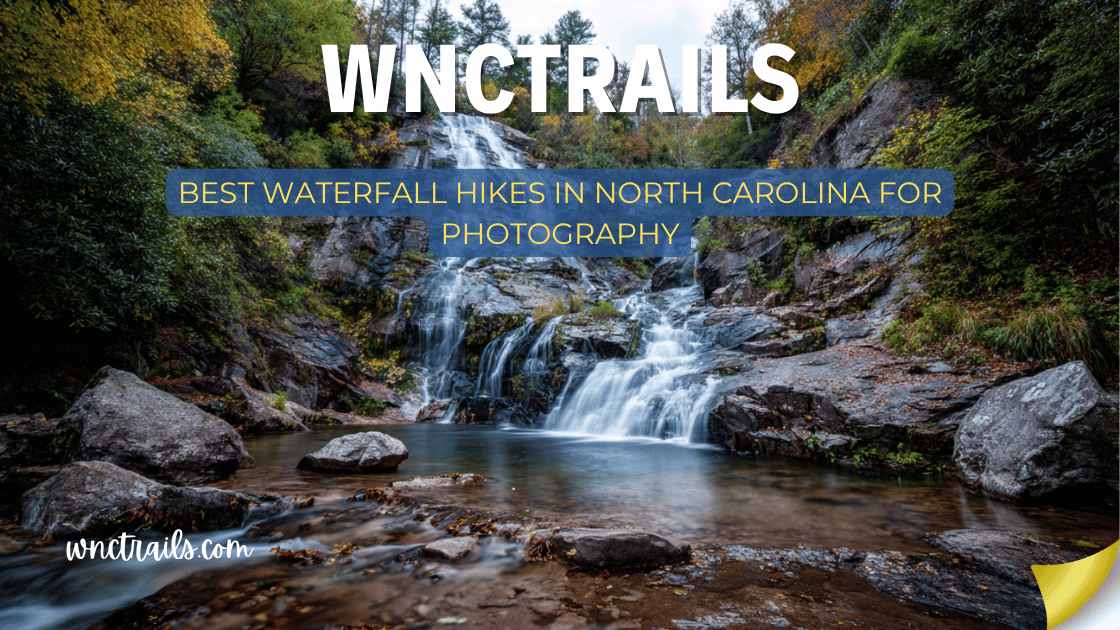
Best Waterfall Hikes In North Carolina For Photography
North Carolina’s waterfalls have defeated more photographers than they’ve rewarded — not because the falls aren’t beautiful, but because most people arrive at the wrong time, with the wrong settings, and leave with the wrong shots.
A waterfall photograph isn’t made at the waterfall. It’s made in the planning: knowing which direction the falls face, when the light window opens, what shutter speed produces silk versus frozen droplets, and where the single best composition lives. Get those decisions right before you leave the trailhead and the photograph is mostly already made. Get them wrong and you’ve got a bright blob of white water in a dark forest.
This guide covers the 15 best waterfall photography locations in North Carolina — ranked by photographic opportunity, not just scenery — with the specific technical and logistical information you need to capture each one. Light direction, best shutter speeds, ideal season, exact vantage points, and the compositional opportunities that most photographers miss.
Best Waterfall Hikes in North Carolina for Photography: 15 Waterfalls Worth Every Shot
Recommended Tools
Disclosure: This page may contain affiliate links.
- Water Shoes — Check current pricing
- Rain Jacket — Check current pricing
- Dry Bag — Check current pricing
How We Chose: Decision Criteria for Waterfall Photography Hikes
- Photo Access & Angles (40%) – How easily can you reach optimal shooting spots? Are multiple perspectives available? Is there safe access for gear setups?
- Lighting & Timing Control (30%) – Does the waterfall face the right direction for morning or evening light? Are there shaded options for long exposures?
- Trail Difficulty & Workflow Fit (30%) – Is the hike manageable with photography equipment? Are there obstacles or risks that could disrupt a focused photo session?
Photo access gets the largest weight because even a stunning waterfall is of little use if you can’t safely reach a good vantage point, especially with camera gear. Lighting control is crucial for exposure, color, and timing flexibility. Trail difficulty matters for workflow: a technical scramble is less appealing if you’re carrying tripods or want to shoot multiple locations in a day.
Quick Reference: NC Waterfalls for Photography
| Waterfall | Best Light Window | Composition Style | Difficulty | Season Rating | Tripod Essential? | GPS |
|---|---|---|---|---|---|---|
| Looking Glass Falls | 8–10 AM (spring/fall) | Wide symmetrical curtain | Easy | ⭐⭐⭐⭐⭐ All seasons | Yes | 35.3113°N, 82.7681°W |
| Moore Cove Falls | Overcast any time | Behind-curtain backlit | Easy | ⭐⭐⭐⭐ Spring | No | 35.3097°N, 82.7545°W |
| Triple Falls | 9–11 AM overcast | Multi-tier vertical | Easy-Mod | ⭐⭐⭐⭐⭐ Fall | Yes | 35.2089°N, 82.6231°W |
| High Falls (DuPont) | 10 AM–12 PM | Full-face vertical | Easy | ⭐⭐⭐⭐ Spring/Fall | Yes | 35.2143°N, 82.6175°W |
| Bridal Veil (DuPont) | 3–5 PM (fall) | Backlit from inside | Easy | ⭐⭐⭐⭐⭐ All seasons | Yes | 35.2167°N, 82.6192°W |
| Linville Falls | Sunrise / overcast | Gorge compression | Moderate | ⭐⭐⭐⭐⭐ Fall | Yes | 35.9575°N, 81.9282°W |
| Whitewater Falls | 10 AM–1 PM | Scale + layered ridge | Easy | ⭐⭐⭐⭐ Spring | Yes | 35.0299°N, 82.9997°W |
| Graveyard Fields | Overcast / sunrise | Alpine meadow + falls | Moderate | ⭐⭐⭐⭐⭐ Fall | Yes | 35.3230°N, 82.8552°W |
| Crabtree Falls | 9 AM–12 PM | Plunge + rhododendron | Moderate | ⭐⭐⭐⭐⭐ June | Yes | 35.8210°N, 82.1441°W |
| Courthouse Falls | Overcast | Circular pool reflection | Easy-Mod | ⭐⭐⭐⭐ Spring | Yes | 35.2437°N, 82.9319°W |
| Rainbow Falls | 1–3 PM sunny | Rainbow + mist | Hard | ⭐⭐⭐⭐⭐ Summer | Yes | 35.0883°N, 82.9429°W |
| Twin Falls | Overcast morning | Dual plunge wide-angle | Moderate | ⭐⭐⭐⭐ Spring | Yes | 35.2301°N, 82.9541°W |
| Hickory Nut Falls | 10 AM–2 PM | Scale + gorge wall | Moderate | ⭐⭐⭐⭐ Spring | Yes | 35.4321°N, 82.2369°W |
| Catawba Falls | Overcast morning | Tiered cascade + gorge | Moderate | ⭐⭐⭐⭐⭐ Fall | Yes | 35.6459°N, 82.2137°W |
| Upper Creek Falls | Midday overcast | Long cascade sequence | Mod-Hard | ⭐⭐⭐⭐ Spring | Yes | 35.8847°N, 81.9102°W |
Season Rating reflects combined factors: waterfall volume, surrounding scenery, and light quality.
The Fundamentals: Waterfall Photography in North Carolina
Before getting to specific locations, a set of principles that apply across all of them.
The Light Problem at NC Waterfalls
Most North Carolina waterfalls sit in narrow creek hollows hemmed by 60–80-foot forest canopy. Direct sunlight reaches the falls for, at most, 3–4 hours per day — and often far less. When direct sun hits a waterfall in a dark forest, the result is almost always a blown-out white wash surrounded by underexposed shadow. The contrast ratio is simply beyond what most cameras can capture in a single exposure.
The solution: photograph NC waterfalls in diffused light. This means overcast days, or the narrow window before direct sun reaches the hollow, or late afternoon after the sun has moved off the falls face.
The best light for NC waterfall photography is flat, even cloud cover. An overcast morning when the sky acts as a giant softbox reduces the contrast ratio to something manageable, saturates the colors of wet rock and green moss, and extends your shooting window to hours rather than minutes.
This is counterintuitive for many photographers. You drove two hours to get here — you want sunshine. But the falls that look best in person on a sunny day often photograph worst. The falls that seem dull on an overcast day are where the best images come from.
Specific light windows by falls orientation are provided in each waterfall section below. These are the narrow windows when direct (but low-angle) light creates workable conditions even on clear days — typically within the first 60–90 minutes after sunlight reaches the falls, before contrast becomes unmanageable.
Shutter Speed: The Silk vs. Frozen Decision
Two distinct aesthetic approaches define waterfall photography, and both are valid:
Silk/Motion Blur (1/4 sec to 4 seconds): The flowing water becomes soft, creamy, and motion-filled. This is the “classic” waterfall photography look. Requires a tripod and typically ND filters in daylight to achieve long enough exposures.
Frozen Motion (1/500 sec to 1/1000 sec): Individual water droplets are sharp, catching the light as sparkle points. This is more dynamic and energetic than the silk approach, and requires no ND filter. Often more dramatic at high-flow falls (Linville, Whitewater) where individual droplets have weight.
The choice is personal, but a few context-specific notes:
- High-volume, dramatic falls (Linville, Whitewater, Rainbow) often photograph better with frozen motion — the individual water mass deserves to be seen in detail.
- Multi-tiered or wide curtain falls (Looking Glass, Triple Falls) photograph better with silk — the motion lines emphasize the geometry.
- Fan falls and cascades (Setrock Creek, Grassy Creek) respond well to either approach depending on flow volume.
Practical shutter speeds:
- 2–4 seconds: Maximum silk, water fully smoothed
- 0.5–1 second: Partial silk, some texture visible
- 1/15–1/30 sec: Natural motion, minimal silk
- 1/250–1/1000 sec: Frozen droplets, action feel
Essential Gear for NC Waterfall Photography
Non-negotiable:
- Tripod: Most waterfall photography requires exposures of 0.5–4 seconds. A stable tripod is the difference between sharp and unusable. Carbon fiber is lighter for long hikes; aluminum is sufficient for shorter approaches.
- Remote shutter release or 2-second timer: Camera shake at 1-second exposure is significant without a remote trigger.
- Lens cloth / microfiber: Waterfall mist lands on your front element constantly. Plan to wipe every 3–5 shots.
Highly recommended:
- Circular polarizing filter: Removes glare from wet rocks, saturates leaf and moss colors, reduces bright-sky reflections in pool surfaces. A polarizing filter makes more difference at NC waterfalls than any other single piece of equipment.
- ND filter (6-stop or 10-stop): For achieving silk exposures in daylight without stopping down to diffraction-limit apertures. Most useful at higher-light locations (Whitewater Falls, Hickory Nut Falls, midday shooting).
- Rain cover for camera: Mist at high-volume falls (Rainbow Falls, Linville Falls during high water) is continuous and soaking. A simple plastic rain cover ($15) is sufficient.
Lens choices:
- Wide-angle (16–35mm): The primary lens for most NC waterfall photography. Emphasizes the height of the falls, includes the surrounding forest frame, captures the pool foreground. Most of the key compositions in this guide are wide-angle.
- Standard zoom (24–70mm): Versatile, handles most situations, less dramatic than wide at the falls themselves.
- Telephoto (70–200mm): For compression effects (Linville Falls gorge, Hickory Nut Falls scale), isolating specific tiers of multi-level falls, shooting across wide pool surfaces from a distance.
Footwear note for photographers: Most waterfall photography requires getting to wet, mossy rock edges. Waterproof trail shoes or boots are standard kit — not optional. You’ll lose good compositions to dry footwear every time.
The 15 Best NC Waterfalls for Photography
1. Looking Glass Falls — Pisgah National Forest
The Reference Shot
Light direction: Northeast-facing | Best window: 8:00–10:30 AM (spring/fall) or full overcast | Tripod: Essential
GPS: 35.3113°N, 82.7681°W | Trailhead: US-276, Pisgah Ranger District
Looking Glass Falls is North Carolina’s most photographed waterfall — a 60-foot symmetrical curtain drop over a smooth granite face that provides the single most technically clean waterfall composition in the state. When conditions align, the shot is almost effortless. When they don’t, it’s frustrating.
The geometry: The falls are nearly as wide as they are tall. The face is smooth and continuous. The pool below is broad and reflective. The stone steps on the left bank and the overhanging hemlocks on both sides create a natural frame. These elements combine to produce a composition that virtually composes itself from the main viewing platform — wide angle at 16–20mm, falls centered, pool in the foreground, sky excluded.
Light analysis: Looking Glass faces roughly northeast. In spring and fall (when the sun rises more northerly), direct sunlight reaches the falls face between approximately 8:00–10:30 AM. In summer (sun rising more northerly and setting higher), the light window shifts earlier and the angle is sharper. In winter, the sun barely reaches the hollow.
The optimal clear-day conditions: arrive at 8:00 AM, shoot the falls in the first 60–90 minutes of direct light before the contrast becomes unmanageable. On overcast days, shoot any time — the diffused light is uniformly good.
The foreground option: The stone steps descend to within 30 feet of the pool’s edge. Wade into the pool edge (waterproof footwear required) for a low-angle composition with the pool surface as foreground. A circular polarizer reveals the underwater rock structure in the shallow entry area. This low-angle shot is less common than the platform view and typically stronger.
The crowd problem: Looking Glass Falls is one of the most visited roadside waterfalls in the Southeast. On weekends from April through October, the viewing area is continuously occupied. Serious photography requires arriving before 8:00 AM or after 5:00 PM (summer light allows late shooting; fall light fades quickly). Weekday mornings in shoulder season (late March, November) offer the best combination of conditions and access.
Winter: In cold winters, Looking Glass develops ice formations on the surrounding rock faces — icicles from the spray zone, frost crystals on the hemlock branches, occasional ice sheeting on the viewing platform railing. A winter ice visit requires micro-spikes or traction devices (the stone steps become treacherous), but the images are extraordinary and differ completely from the standard summer shot.
2. Moore Cove Falls — Pisgah National Forest
The Behind-the-Curtain Shot
Light direction: East-facing | Best window: Full overcast any time | Tripod: Recommended
GPS: 35.3097°N, 82.7545°W | Trailhead: US-276 pullout, south of Looking Glass Falls
Moore Cove Falls offers a composition available almost nowhere else in North Carolina: shooting from inside the waterfall, through the curtain, with the forest beyond. The overhang geometry — the falls drop outward from the rock face rather than straight down — creates a dry alcove behind the curtain that is spacious enough for a photographer with a tripod.
The technique: Position the tripod in the alcove, angling the lens toward the waterfall curtain. The falls become a foreground element rather than a subject — a translucent white veil through which the creek, the trail, and the forest are visible. The light filtering through the water creates a soft, diffused glow.
Exposure challenge: The contrast between the lit exterior (forest, sky) and the dim interior (rock overhang, alcove walls) is significant. Solutions:
- Expose for the exterior and let the interior go dark, creating a frame effect
- Bracket 3–5 exposures and blend in post-processing
- Shoot when the exterior is fully overcast (reduces the contrast ratio to manageable levels)
The spring wildflower layer: The Moore Cove trail in April–early May runs through trillium, wild geranium, and Solomon’s seal. The 0.7-mile approach produces excellent foreground subjects before you even reach the falls. Consider shooting the approach flowers as part of the same visit.
Lens: 24–35mm equivalent gives the most useful behind-curtain composition. Wider creates distortion at the close working distance; longer narrows the frame too much.
3. Triple Falls — DuPont State Recreational Forest
The Multi-Tier Composition
Light direction: Generally northwest-facing | Best window: Morning overcast | Tripod: Essential
GPS: 35.2089°N, 82.6231°W | Trailhead: Hooker Falls Access Area, DuPont
Triple Falls’ three-tier, 120-foot cascade is one of the most compositionally interesting waterfall sequences in NC — three distinct drops at different widths and volumes, each separated by a ledge or pool. Capturing all three in a single frame requires the right position; capturing each individually requires moving between vantage points.
The three-tier composition (all falls in frame): Position on the left-bank viewing platform using a wide-angle (16–24mm). The platform is positioned to include upper, middle, and lower tiers in a single vertical frame. A tripod is necessary for the 1–2 second exposure that produces silk on all three tiers simultaneously. This is the Hunger Games shot that drove DuPont’s fame.
The middle-tier composition (close approach): Descend from the platform to the rock ledge at the middle tier. From here, the largest individual drop (approximately 60 feet) fills the frame. A slightly longer focal length (35–50mm) compresses the drop face. Mist from this position is significant — plan to wipe the lens frequently.
The lower-tier reflection: In calm conditions after morning mist has settled, the pool at the base of the lower tier produces a partial reflection of the falls. A low-angle position with the polarizer rotated to maximize reflection visibility (partially off-polarization) captures falls + reflection in a single frame.
Fall color context: Triple Falls in the third week of October, with orange and yellow canopy on both banks, and the three-tier cascade through the color frame, is among the five best fall color waterfall images in the state. Arrive before 8:30 AM to have the falls to yourself.
4. High Falls — DuPont State Recreational Forest
The Scale Shot
Light direction: South-facing | Best window: 10 AM–12 PM | Tripod: Essential
GPS: 35.2143°N, 82.6175°W | Trailhead: High Falls Access Area, DuPont
At 150 feet, High Falls is DuPont’s tallest waterfall — a single-plunge drop over a clean granite face that rewards a straightforward compositional approach: the full-face view from the base, with the plunge pool in the foreground and the falls height filling the frame.
The full-face composition: Wide angle (16–20mm) from the base rock shelf. The falls face south, meaning midday provides the most direct light — unusual for waterfall photography, where midday light is typically harsh. But High Falls’ south-facing orientation means the light angle is from above (slightly softened) rather than harsh side-light. Shoot between 10 AM and noon for the best balance of direct illumination and manageable contrast.
The top-down composition: An elevated trail on the right bank provides a bird’s-eye view looking down into the plunge pool. This perspective is uncommon in NC waterfall photography and creates an unusual foreshortened composition — the falls compressed into a shorter apparent height with the pool directly below.
The scale reference: High Falls benefits from including a human element — a person at the base establishes the scale that makes 150 feet legible. Ask a companion to stand at the pool edge (well back from the water) for a shot that communicates the falls’ actual size.
In high water: High Falls in spring flood changes character — the volume increases dramatically and the spray field extends 30–50 feet from the base. Bring full weather protection for camera gear in high-water spring visits.
5. Bridal Veil Falls — DuPont State Recreational Forest
The Backlit Curtain
Light direction: East-facing | Best window: 2–4 PM (fall/spring) | Tripod: Essential
GPS: 35.2167°N, 82.6192°W | Trailhead: High Falls Access Area, DuPont
Bridal Veil Falls provides DuPont’s most technically interesting photographic challenge: shooting through a falling water curtain from behind, with the exterior landscape and sky visible through the water. When late-afternoon light catches the curtain at angle, the result is a backlit spray that produces one of the more ethereal waterfall images in North Carolina.
The backlit technique: Position in the dry alcove behind the falls in mid-to-late afternoon (the falls face roughly east, so afternoon light comes from behind the photographer and through the curtain from outside). As the sun drops toward the western ridgeline, its light angles through the falls and creates backlit droplets — each one catching light individually, producing a gold-spark curtain effect.
This is a weather-dependent, time-sensitive composition. The window is approximately 2–4 PM in fall and spring (when the sun angle is low enough to penetrate the alcove). On overcast days, the backlit effect is absent — shoot the standard looking-outward composition instead.
The looking-outward composition: From inside the alcove, facing the forest. The falls curtain is on the left (or right) of the frame; the forest, trail, and creek are visible through and beyond the falls. A 24–35mm lens captures the spatial relationship between the protected interior and the exposed exterior. Long exposure (1–2 seconds) smooths the curtain.
Combined DuPont photography day: High Falls and Bridal Veil share a trailhead. Visit High Falls first (morning, better light for the face-on shot), then Bridal Veil in the afternoon for the backlit curtain work. Two completely different compositions from the same starting point.
6. Linville Falls — Blue Ridge Parkway
The Gorge Compression
Light direction: Various (multiple viewpoints) | Best window: Sunrise + overcast | Tripod: Essential
GPS: 35.9575°N, 81.9282°W | Trailhead: Linville Falls Recreation Area, BRP MP 316.4
Linville Falls is NC’s most compositionally complex waterfall — not because the falls themselves are the most dramatic, but because the gorge setting creates photographic depth unavailable at any other NC waterfall. The falls drop 90 feet into a gorge 2,000 feet deep, and the Erwin’s View overlook frames the falls against the layered ridgelines of the gorge walls and the forest below.
The gorge compression shot: Erwin’s View overlook. A telephoto lens (100–200mm equivalent) compresses the gorge layers — falls in foreground, gorge wall behind, ridgeline forest beyond. The compression makes the gorge feel narrower and more dramatic than the wide-angle view. This shot is counterintuitive (most photographers grab a wide lens) but produces stronger results at Linville than any other approach.
The sunrise window: Linville Falls faces roughly southwest, which means sunrise light doesn’t illuminate the falls face directly. However, sunrise from Erwin’s View lights the gorge walls and ridgelines while the falls remain in shadow — producing a dramatic contrast between lit stone and dark water that is extraordinary for roughly 20 minutes. This requires arriving at least 30 minutes before sunrise and setting up in pre-dawn darkness. The trail from the parking area is short enough to navigate by headlamp.
The Plunge Basin view: The Plunge Basin overlook (south-side trail) provides a view looking up at the lower falls from below the rim — a perspective that emphasizes the falls’ height relative to the gorge floor and shows the plunge pool framed by gorge walls. Wide-angle with maximum foreground depth creates a sense of being inside the gorge rather than looking at it. This trail is less visited than Erwin’s View, meaning less crowd interference in the composition.
Fall color: Linville Falls in peak fall (typically mid-October at 3,000-foot elevation) provides one of the most complete fall color waterfall compositions in the state — the gorge’s layered ridgelines show color at multiple distances, creating a color-depth effect unavailable at single-plane falls. Plan the shot for the week when the near-gorge deciduous trees (oaks and maples framing Erwin’s View) are at peak.
7. Whitewater Falls — Nantahala National Forest
The Scale Statement
Light direction: Northeast-facing | Best window: 9–11 AM overcast | Tripod: Essential
GPS: 35.0299°N, 82.9997°W | Trailhead: Whitewater Falls Recreation Area, Hwy 281 south of Cashiers
At 411 feet, Whitewater Falls is the tallest waterfall east of the Rocky Mountains — and photographing it requires confronting a problem that smaller falls don’t pose: scale communication. A 411-foot waterfall in a photograph looks approximately the same as a 100-foot waterfall unless you have compositional elements that establish the true scale.
The main overlook composition: The paved viewing platform at the main overlook frames the full falls from above — you’re looking slightly downward at the drop, with the surrounding forest and the lower river visible below. From this position, a wide-angle lens captures the full 411-foot drop in frame (barely — you’ll need to go to 16mm or wider). The problem: without scale reference, the image reads as “impressive waterfall” but doesn’t communicate “tallest east of the Rockies.”
Solutions:
- Include the platform railing and/or other visitors in the foreground — establishes human scale
- Wait for a bird (ravens are common around the gorge) to fly past the falls face — a bird against 411 feet of falling water establishes scale immediately
- Use the lower overlook viewpoint (additional 0.5-mile hike from the main overlook) for a perspective looking upward at the falls, which makes the height more visceral
Telephoto isolation: A telephoto lens (200mm+) isolates individual sections of the falls — particularly effective at high water when distinct water masses are visible at different points along the 411-foot drop. This produces an abstract pattern of water-on-rock that doesn’t depend on scale communication.
The early arrival priority: Whitewater Falls is a 60–70 minute drive from Asheville and Brevard, making it a longer commitment than Pisgah or DuPont falls. The parking area fills by 10 AM on summer and fall weekends. If you’re making the drive for photography, plan for a 7:30–8:00 AM arrival.
Upper Whitewater Falls: A shorter falls (200 feet) accessible via a 1.5-mile trail above the main falls. Less visited, different character — more cascading than plunge. Often overlooked by photography-focused visitors who come only for the main falls.
8. Graveyard Fields — Blue Ridge Parkway
The Alpine Context Shot
Light direction: Northeast-facing | Best window: Sunrise or full overcast | Tripod: Essential
GPS: 35.3230°N, 82.8552°W | Trailhead: Graveyard Fields Overlook, BRP MP 418.8
Graveyard Fields’ photographic value lies not primarily in the falls themselves — both Second Falls (60 feet) and Upper Falls (50 feet) are beautiful but not technically unusual — but in the landscape context. At 5,120 feet, surrounded by spruce-fir forest and open bog meadow, Graveyard Fields looks nothing like the rest of NC’s waterfall destinations. The high-elevation setting is the photograph.
The meadow + falls composition: The key shot at Graveyard Fields combines the bog meadow (bog grasses turning deep amber and red in September–October) with the falls in the background and the spruce-fir ridgeline beyond. This requires positioning in the open meadow upstream of Second Falls rather than at the standard platform viewpoint. From the meadow, wide angle (16–20mm) captures the bog foreground, the creek winding through it, the falls in the middle distance, and the spruce ridgeline as background — a layered landscape composition unavailable at any other NC waterfall.
The sunrise window: Graveyard Fields is accessible before sunrise if you arrive the night before (Mount Pisgah Campground is 10 miles north on the BRP). Sunrise on the open meadow at 5,100 feet — alpenglow on the spruce tops, mist over the bog, the first light warming the amber grasses — is among the finest dawn landscapes in western NC. The falls are secondary; the light on the meadow is primary.
Upper Falls specifically: Upper Falls (the extension hike) photographs better than Second Falls for a straightforward falls composition — the curtain geometry and plunge pool are cleaner. The creek crossing (wet feet) and the shorter trail section create a slightly more intimate, less-visited setting that results in cleaner images without strangers in the background.
Fall peak timing: The bog grasses at Graveyard Fields turn before the deciduous forest below — the meadow is at peak amber-red color in the third week of September through early October, typically 2–3 weeks before the valley floor reaches peak. The combination of fall-colored meadow, spruce-fir backdrop, and operating waterfalls is the definitive fall photography moment at this location.
9. Crabtree Falls — Blue Ridge Parkway
The Rhododendron Frame
Light direction: East-facing | Best window: Morning overcast, mid-June | Tripod: Essential
GPS: 35.8210°N, 82.1441°W | Trailhead: Crabtree Meadows Campground, BRP MP 339.5
Crabtree Falls is at its peak photographically for approximately two weeks per year: when the Catawba rhododendron surrounding the plunge pool is in full bloom, typically June 10–25. During this window, the 70-foot plunge falls through a frame of deep pink-purple flowers — a composition that doesn’t exist at any other time of year.
The peak bloom shot: Wide angle (16–24mm) from the base platform with the rhododendron branches framing the top and sides of the falls. A horizontal composition works better here than vertical — the rhododendron blooms extend horizontally across both banks, and a vertical frame cuts off too much of the flower mass. Time exposure (1–2 seconds) smooths the falls while the rhododendron blooms remain sharp in the foreground.
Bloom timing confirmation: Catawba rhododendron bloom timing varies by year — typically 2–3 weeks from bud to drop at a given elevation. Check recent AllTrails reviews or the Blue Ridge Parkway’s social channels in early June. When reviewers start mentioning blooms at Crabtree, plan your visit for the following 10–14 days.
Non-bloom season: Crabtree Falls is worth photographing outside bloom season — the falls geometry is strong, the surrounding forest is excellent for fall color, and the relative solitude (compared to Linville and Graveyard Fields) means you can take time setting up without traffic. But the bloom window is when Crabtree becomes genuinely exceptional.
10. Courthouse Falls — Pisgah National Forest
The Circular Pool Reflection
Light direction: West-facing | Best window: Full overcast | Tripod: Essential
GPS: 35.2437°N, 82.9319°W | Trailhead: FR-140, Pisgah National Forest
Courthouse Falls offers a compositional opportunity unique in NC: a circular plunge pool that functions as a near-perfect natural mirror. The 40-foot plunge drops into this circular basin, and in calm conditions (early morning, no wind, low flow), the pool’s surface reflects the falls almost symmetrically.
The reflection composition: Low-angle position at pool edge, lens close to the water surface. Wide angle (16–20mm) captures both the falling water and its reflection in a single frame. A circular polarizer, rotated to approximately 45-degrees off maximum polarization, allows partial reflection while reducing some glare — the goal is maintaining the reflection while adding pool depth rather than eliminating glare entirely.
This composition works best in very still conditions — any breeze breaks the pool surface and kills the reflection. Early morning (before any trail traffic) and immediately after sunrise (before wind picks up) provide the most reliable calm conditions.
The geological context shot: The circular pool is unusual enough to warrant documentation — the widest available lens (8–16mm fisheye if you have it, otherwise 16mm rectilinear) looking straight down into the pool from the falls lip captures the full circle. This requires scrambling to the top of the falls, which is accessible on the left bank. Use appropriate caution.
Overcast priority: Courthouse Falls faces west, meaning it’s in shadow most of the morning and receives direct afternoon sun. Direct afternoon sun on a west-facing falls creates harsh side-light that obscures the pool reflection. Overcast conditions neutralize this — the best Courthouse Falls photography happens on cloudy days.
11. Rainbow Falls — Gorges State Park
The Rainbow Shot
Light direction: East-facing | Best window: 1:00–3:00 PM sunny | Tripod: Yes for falls / No for rainbow
GPS: 35.0883°N, 82.9429°W | Trailhead: Gorges State Park, Bald Rock Rd
Rainbow Falls produces a permanent rainbow in its mist cloud — a meteorological constant created by the angle of the falls, the volume of the mist, and the surrounding gorge walls — but only when three conditions align: direct afternoon sunlight, sufficient water volume, and you’re standing in the right position.
The rainbow window: The rainbow appears in the mist cloud between approximately 1:00 PM and 3:00 PM on sunny days, when the sun is in the southwest and its light passes through the mist at the angle required for refraction. Visit on a clear afternoon and position yourself in front of the mist cloud (at the base viewing area) facing the falls. The rainbow appears in the mist between you and the water.
Exposure for rainbow photography: the rainbow and the falls are in the same frame but at different exposure requirements. Meter for the rainbow mist (typically 1–2 stops brighter than the falls) and let the falls slightly overexpose — the rainbow is the subject, not the waterfall. Shutter speed of 1/125–1/250 second captures both the rainbow and the water motion at an intermediate stage.
The full-face composition (non-rainbow): Rainbow Falls is 150 feet tall and drops in a single plunge — the composition is straightforward but the scale is impressive. Early morning overcast visits (without the rainbow) are appropriate for the falls as subject. The mist volume at Rainbow Falls is significant — rain cover for camera essential, lens cloth in hand for every shot.
The commitment: Rainbow Falls requires a 2.5-mile, 1,100-foot climb to reach. This is the most physically demanding waterfall in this guide. Bring 2 liters of water, plan for 5+ hours total. The photography opportunity justifies the effort — but only if you’re fit enough to enjoy the walk rather than just survive it.
12. Twin Falls — Pisgah National Forest
The Dual Plunge
Light direction: Varies by fork | Best window: Morning overcast | Tripod: Essential
GPS: 35.2301°N, 82.9541°W | Trailhead: FR-225B near Lake Logan, Pisgah National Forest
Twin Falls provides a compositional challenge that no other NC waterfall offers: two separate waterfalls dropping from different angles into the same basin simultaneously. The East Fork and West Fork create a visual conversation rather than a single-subject image.
The full basin wide-angle: From the basin floor, a wide-angle lens (16–20mm) captures both falls in a single frame. Neither falls dominates — they share the frame as equal subjects. This works best on overcast days when both falls are lit evenly (direct sun typically lights one fork while leaving the other in shadow).
The individual fork approach: Each fork also deserves individual treatment. The left fork (East Fork, typically larger) is a more vertical plunge; the right fork (West Fork) is a broader curtain. Shooting each independently with a slightly tighter focal length (24–35mm) captures the character of each.
The convergence foreground: The two streams converge at the basin before flowing downstream together. A low-angle wide-angle composition with the confluence as foreground, both falls in background, creates a visual narrative of the two streams meeting. This foreground requires getting close to the water — waterproof footwear essential.
13. Hickory Nut Falls — Chimney Rock State Park
The Scale Context
Light direction: West-facing | Best window: 10 AM–2 PM | Tripod: Yes (for falls) / No (for overview)
GPS: 35.4321°N, 82.2369°W | Trailhead: Chimney Rock State Park, Hwy 64/74A
At 404 feet, Hickory Nut Falls is the second-tallest waterfall in this guide and the most dramatic scale subject in the NC Piedmont foothills. The waterfall drops off the Blue Ridge escarpment face into Hickory Nut Gorge — the same gorge visible from the Chimney Rock summit — providing both a close-up waterfall composition and a distant landscape composition unavailable at most NC falls.
The close approach (base viewpoint): The Hickory Nut Falls Trail climbs 800 feet to a viewing platform approximately 100 feet from the falls base. From here, wide angle (16mm) barely captures the full 404-foot drop. A vertical composition is necessary — the falls are far taller than wide. Long exposure smooths the water; frozen motion captures the individual streams that fracture off the main flow as the water descends.
The distant gorge composition: From Chimney Rock summit (accessible via a separate trail or the park elevator), Hickory Nut Falls is visible as a white thread on the gorge wall approximately 0.8 miles away. A telephoto lens (200–300mm) compresses the gorge and makes the falls legible at this distance. This shot establishes the geological context — the escarpment, the gorge depth, and the waterfall’s relationship to the cliff face — that close-up base shots don’t provide.
The combined visit: Photograph the falls close-up on the ascent (morning light — the falls face west, so overcast morning works well). Continue to Chimney Rock summit for the telephoto landscape shot in the afternoon as the gorge opens up in full sun.
14. Catawba Falls — Pisgah National Forest (Eastern)
The Tiered Cascade + Gorge
Light direction: North-facing gorge | Best window: Overcast all day | Tripod: Essential
GPS: 35.6459°N, 82.2137°W | Trailhead: Catawba Falls Trailhead, Old Fort Road
Catawba Falls’ 100-foot multi-tiered cascade sits in a north-facing gorge that receives almost no direct sunlight — which makes it ideal for photography at any time of day. The falls run through three distinct tiers in a narrow canyon, and the combination of gorge walls, hemlock canopy, and tiered water creates compositional depth unavailable at open-face falls.
The tiered cascade composition: From the main viewpoint at the falls base, a wide angle (16–24mm) captures the two primary tiers visible from ground level — the 40-foot upper cascade and the 60-foot lower plunge. The gorge walls on both sides provide vertical framing. Long exposure (2–4 seconds) in the low-light gorge produces maximum silk.
The ledge view (upper tier): A short scramble on the left bank (use hands, no technical climbing) reaches a ledge with a close-up view of the upper tier. From this position, a standard zoom (35–50mm) isolates the upper cascade without the distracting foreground of the lower plunge. Less common composition, often stronger.
Fall color in the gorge: The Catawba Falls gorge in mid-to-late October (peak fall at ~2,000 feet elevation) provides one of the richest fall color waterfall settings in NC — dense hardwood forest on both gorge walls, the water visible through the fall canopy. The combination of fall color and the north-facing gorge’s soft, even light makes this one of the best fall photography destinations in the state.
Crowd advantage: Catawba Falls is 45 minutes from Asheville in a different direction than Pisgah — it’s east, not west. The result is dramatically lower crowd pressure even in peak season. You’ll often have the falls entirely to yourself on weekend mornings when every Pisgah trailhead is full.
15. Upper Creek Falls — Pisgah National Forest (Northern)
The Long Cascade Sequence
Light direction: North-facing | Best window: Overcast midday | Tripod: Essential
GPS: 35.8847°N, 81.9102°W | Trailhead: Upper Creek Trailhead, Collettsville Road
Upper Creek Falls drops 150 feet in the longest single cascade sequence in Pisgah National Forest — a 90-foot upper cascade visible from a ridge overlook and a 60-foot lower plunge accessible by scramble. The two-section structure provides two distinct photographs rather than one.
The overview composition: The ridge overlook (approximately 2.5 miles from the trailhead) looks down and across to the upper cascade — a broad view that places the falls in the context of the surrounding ridgeline and valley. A medium telephoto (70–100mm) compresses the ridgeline layers effectively. This is a landscape-with-waterfall rather than a waterfall-in-landscape.
The base composition: Scrambling to the base of the lower plunge (steep but non-technical) puts you in a narrow rocky gorge looking up at 60 feet of falling water. Wide angle (16mm), vertical orientation, long exposure. The gorge walls frame the falls tightly.
Combined in sequence: Upper Creek is best photographed as a two-composition visit: the overview shot from the ridge, then the descent to the lower plunge. They are fundamentally different images and justify the longer approach.
The Best NC Waterfall Photography Itineraries
The One-Day Pisgah Photography Loop
For photographers based in Brevard or Asheville
Covers three distinct compositions in a single efficient day in the Davidson River corridor.
- 7:00 AM — Looking Glass Falls (arrive at the light window, empty viewing area)
- 8:30 AM — Moore Cove Falls (behind-curtain shot, wildflowers in spring)
- 10:00 AM — Drive to Courthouse Falls via NC-215 (45 min from US-276)
- 11:00 AM — Courthouse Falls reflection shot (overcast midday ideal)
- 1:00 PM — Twin Falls hike (3.2 miles, 2+ hours, overcast afternoon)
- 4:30 PM — Return to Brevard for dinner
Best season: April–May for Looking Glass and Moore Cove (wildflowers), year-round overcast days for Courthouse Falls and Twin Falls.
The Two-Day DuPont Photography Intensive
Covers all four major DuPont photography subjects with proper light windows
Day 1 (morning):
- 7:30 AM — Hooker Falls (pool reflection, low angle, morning light)
- 9:00 AM — Triple Falls (three-tier composition on the platform, overcast preferred)
- 11:00 AM — Bridal Veil Falls (walk-behind, standard overcast composition)
Day 1 (afternoon):
- 2:30 PM — Return to Bridal Veil Falls for the backlit curtain shot (afternoon sun through the falls)
- 4:00 PM — High Falls (afternoon light — south-facing, direct afternoon sun works)
Day 2:
- 8:00 AM — Grassy Creek Falls and Corn Mill Shoals (Buck Forest section, different character)
- Afternoon: Shoot Brevard town for supporting website content or travel on to Pisgah
The Blue Ridge Parkway Photography Drive (Two Days)
For photographers doing the NC Parkway corridor specifically
Day 1 (Northern Parkway):
- Pre-dawn departure from Boone
- Sunrise at Price Lake (MP 297) — open water reflections at dawn
- Cascade Falls, E.B. Jeffress Park (overcast mid-morning)
- Drive to Linville Falls — arrive MP 316.4 by 10 AM
- 2+ hours photographing Linville Falls from both overlooks
- Overnight: Linville Falls Campground or Spruce Pine accommodations
Day 2 (Southern Parkway):
- 7:00 AM — Roaring Fork Falls (before other visitors, soft morning)
- 9:30 AM — Crabtree Falls loop (check bloom timing if June)
- 1:00 PM — Glassmine Falls overlook (check for active water)
- 3:30 PM — Arrive Graveyard Fields — Second Falls in late afternoon
- 5:00 PM — Upper Falls if energy allows
- Overnight in Brevard or Asheville
The Fall Color Waterfall Photography Week
The annual NC waterfall photography calendar
The following sequence follows fall color peak from high to low elevation across a 3-week window:
Week 1 (Late September – First week October):
- Graveyard Fields bog meadow + Upper Falls (5,120 ft, earliest color)
- Blue Ridge Parkway northern sections (5,000 ft+)
Week 2 (Second–Third week October):
- Linville Falls gorge (3,000 ft, mid-elevation oak/maple peak)
- Crabtree Falls (3,600 ft, rich hardwood color on the loop)
- Catawba Falls gorge (2,000 ft, approaching peak)
Week 3 (Third–Fourth week October):
- Triple Falls and DuPont forest (2,200–2,600 ft)
- Catawba Falls (peak color at lower elevation)
- Looking Glass Falls (Davidson River valley, late-October peak)
Post-Processing Notes for NC Waterfall Photography
The Standard Waterfall Edit
Most NC waterfall images require these adjustments:
Exposure: Slight underexposure at capture (protect highlights in the water) with shadow lift in post. A slightly underexposed RAW file has more usable data than a blown-highlights file.
White balance: Forest waterfall light is strongly green-cyan due to the canopy. A white balance shift toward warmer tones (increase Kelvin by 200–400K from auto WB) produces more natural-looking rock and water color.
Highlight recovery: Falling water is always the brightest element in the frame. Recover highlights (-40 to -80) to reveal water texture rather than blowing out to pure white.
Clarity and texture: Moderate positive clarity (+10 to +20) adds texture to wet rock surfaces and makes water detail pop. Avoid high clarity values on the water itself — it creates an unnatural, gritty look.
Color grading: The greens in NC forest waterfall images are typically oversaturated in camera. A slight desaturation of greens (-5 to -15 in HSL panel) combined with a luminosity increase produces more natural-looking foliage.
Long Exposure Blending
For falls where the ambient light requires a longer shutter speed than ideal for water motion, bracket two exposures:
- The correct long exposure for the environment (sharp foreground, smooth water)
- A fast exposure (1/250 sec, handheld if necessary) for water detail
Blend in post using the long exposure as the base and masking in the fast exposure’s water texture where desired. This technique produces the best of both approaches.
Frequently Asked Questions
What camera is best for waterfall photography in NC? Any camera with manual exposure control and RAW capture. The differentiating factor is not the camera body — it’s the tripod, the polarizing filter, and the light conditions. A competent photographer with a $400 mirrorless camera and a stable tripod will consistently outperform an inexperienced photographer with a $3,000 body and no tripod.
Do I need ND filters for NC waterfall photography? For overcast conditions (the recommended conditions for most NC falls), often not — the reduced light allows long exposures without ND filtration. For bright-day shooting, a 6-stop ND filter extends exposure time to silk range. A polarizing filter is more universally useful and handles double duty (reduces glare + slightly extends exposure).
When is the worst time to photograph NC waterfalls? Mid-summer (July–August) sunny afternoons. Full sun creates extreme contrast, the falls run lower volume, and the parking areas are crowded. Any NC waterfall in full summer midday sun is a difficult photography subject.
Can I use a smartphone for these compositions? For wide-angle compositions in good (overcast) light, modern smartphone cameras produce usable results at most locations in this guide. The limitations appear in low light (noise), long-exposure work (requires a tripod adapter and third-party app), and telephoto work (digital zoom degrades quality). For casual sharing, smartphones are fine. For print-quality images or professional use, a dedicated camera is necessary.
Which NC waterfall is best for beginning waterfall photographers? Looking Glass Falls: good light window, easy access, clear composition target, no difficult terrain. Moore Cove Falls adds the behind-curtain technique without technical difficulty. These two together in a single morning provide a solid introduction to NC waterfall photography before committing to more demanding locations.
Key Scenarios
- You want a quick sunrise shoot before work, with minimal hiking and safe tripod setups: Choose Looking Glass Falls.
- You’re planning a full day of landscape photography, seeking dramatic overlooks and changing perspectives: Linville Falls is the better fit.
- You want a family-friendly outing with multiple waterfalls and easy access for varied shots: Graveyard Fields works well.
Final Thoughts: What Separates Good from Great Waterfall Photography
The difference between a good NC waterfall photograph and a forgettable one comes down to one thing more than any other: whether you made a decision, or just recorded what was in front of you.
Arriving at Looking Glass Falls and pointing a camera at the falls produces a photograph. Arriving 90 minutes before the light window opens, setting up the tripod at the pool edge, attaching the polarizing filter, waiting for the exact moment when two hikers clear the frame, and exposing at 1.6 seconds produces a different kind of image entirely.
The waterfalls themselves don’t change. The light changes. The water level changes. The season changes. The specific square foot of ground where you place your tripod changes everything about the foreground. These decisions — the ones made before you press the shutter — are the work.
North Carolina has the waterfalls. The question is what you bring to them.
FAQs
- Which waterfall is best for fall color photography? Graveyard Fields offers vibrant foliage and multiple waterfalls in one area.
- Are tripods allowed at these locations? Yes, all listed trails allow tripods, but be mindful of crowds and path space.
- Is there cell service at these waterfalls? Service is limited; download trail maps and check conditions in advance.
- Can you swim at any of these waterfalls? Swimming is permitted at Graveyard Fields, but not recommended at Looking Glass or Linville due to strong currents.
- Are these trails open year-round? Typically yes, but icy conditions can close access in winter—verify with park services before visiting.
Related Guides
- Scenic Waterfall Hikes in North Carolina — Scenery-focused overview of NC’s most beautiful waterfall settings
- Best Waterfall Hikes in North Carolina — General overview across all categories
- Blue Ridge Parkway Waterfall Hikes — Complete Parkway waterfall guide including Linville Falls and Graveyard Fields
- DuPont State Forest Waterfall Hikes — Complete DuPont coverage including Triple Falls and Bridal Veil
- Pisgah Waterfall Hikes — Full Pisgah National Forest guide
WNCTrails.com — Your guide to Western North Carolina trails, waterfalls, and outdoor adventure.
Trail conditions change seasonally. Always verify current access and conditions before departure.