Trail status (checked September 2026) — conditions change; confirm with the managing agency before you go.
- The Catawba Falls loop reopened after Hurricane Helene, but the upper viewing platform and the Wildflower Trail were still closed for repairs. Source: U.S. Forest Service
Not every trail in Pisgah National Forest earns a sunset trip. A waterfall photographs beautifully at noon but disappears into shadow by 6pm, while a bald or granite dome only gets better as the light drops. This page focuses on the trails in our verified Pisgah cluster that actually deliver a payoff at golden hour — open summits, rock domes, and ridgelines with a clear western or panoramic exposure. Below is our honest ranking, plus the practical stuff — parking reality, seasonal timing, and what to bring — so you’re not scrambling down loose rock in the dark.
Best Sunset Hikes in Pisgah National Forest
1. Mount Pisgah Trail (1.3 mi, Moderate)
This is the trail most people mean when they ask about sunset hikes in Pisgah National Forest, and for good reason. It’s short enough to fit into an after-work or after-dinner window, with about 700 feet of elevation change packed into a little over a mile, and it ends at a genuine 360-degree summit view. Because the payoff is a full circle rather than a single direction, you get color in the sky no matter which way the sunset lines up. The tradeoff is that it’s popular — expect company at the top on clear evenings.
2. John Rock Trail (1.8 mi, Moderate)
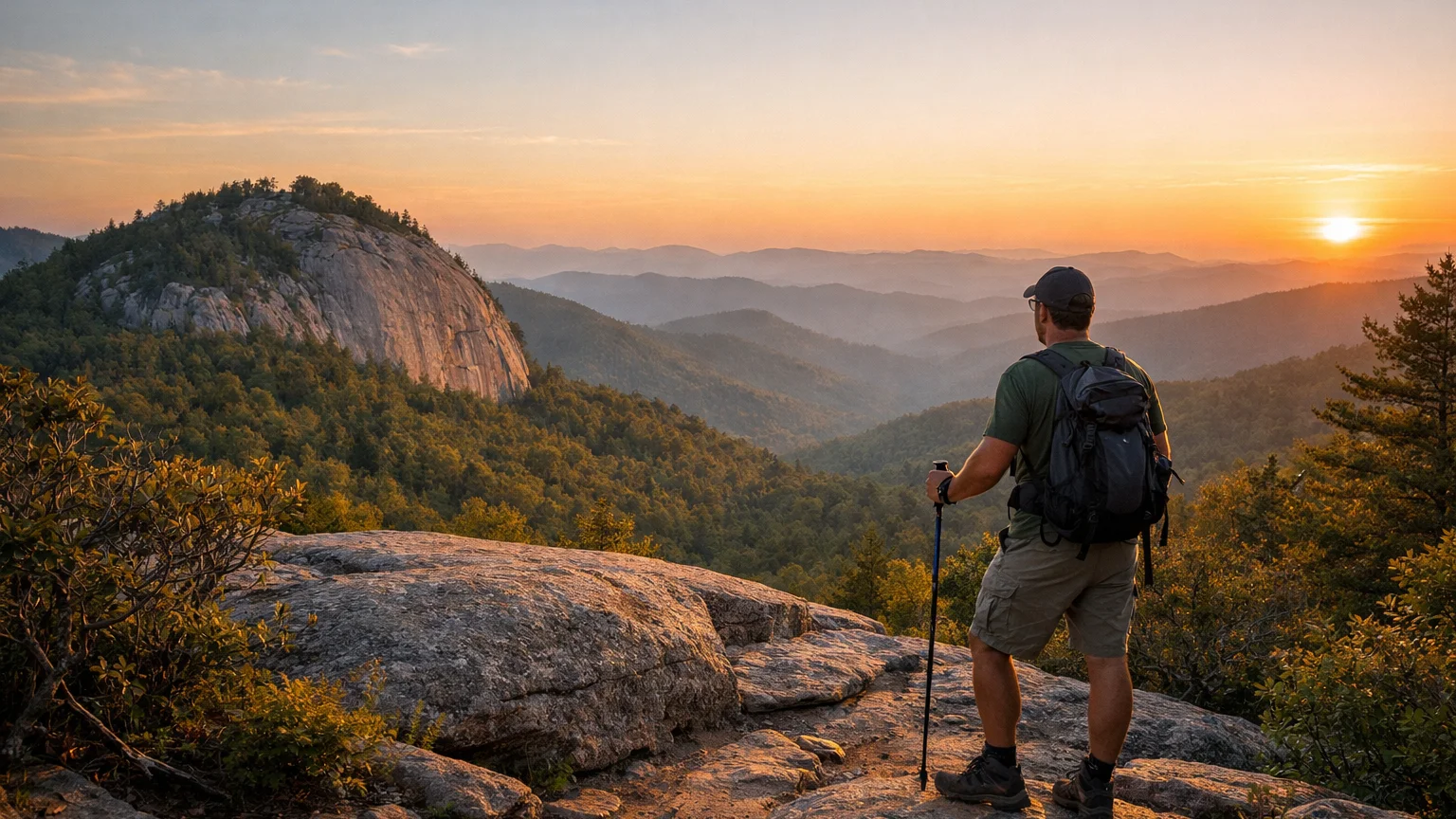
John Rock is a granite dome with a view stretching across the fish hatchery toward Looking Glass Rock and Pilot Mountain. At roughly 750 feet of elevation change over 1.8 miles, it’s a manageable evening hike for most fitness levels, and the open rock face holds heat and light well into early evening. It’s less crowded than Mount Pisgah, which makes it a solid pick if you want the view without the summit traffic.
3. Looking Glass Rock Trail (3.1 mi, Moderate)
This one asks more of you — about 1,700 feet of elevation change over 3.1 miles — but the panoramic summit view is one of the better payoffs in this cluster. Because of the distance and climb, this is a hike you need to start with real time to spare; rushing a descent on this terrain after dark is not something we’d recommend. Treat it as a half-afternoon commitment that ends at sunset, not a quick after-work outing.
4. Art Loeb Spur Trail (0.6 mi, Strenuous)
Short on paper, but don’t let the 0.6 mile distance fool you — this spur is rated strenuous for a reason, gaining around 200 feet in a compressed stretch. What you get for the effort is a panoramic view reported to stretch up to 70 miles on a clear evening. If you want maximum view-to-effort ratio and don’t mind a steep push, this is one of the more efficient sunset hikes in Pisgah National Forest on this list.
5. Cold Mountain Trail (1.4 mi, Strenuous)
Cold Mountain’s summit views come from exposed rock after about 900 feet of climbing in just 1.4 miles — a steep, strenuous stretch that rewards you with one of the more dramatic viewpoints in the area. The exposed nature of the summit means wind and temperature drop fast once the sun goes down, so this is a hike where an extra layer isn’t optional.
6. Old Butt Knob Trail (3.6 mi, Strenuous)
This is the most demanding option in the group, climbing roughly 2,500 feet over 3.6 miles across several knobs with views into Shining Rock Wilderness. It’s a serious undertaking for a sunset hike specifically because of the descent — planning your turnaround time here matters more than on any other trail in this list. This one is better suited to hikers who are confident navigating strenuous terrain in fading light, or who plan to camp rather than hike out the same night.
7. Ivestor Gap Trail (3.7 mi, Easy)
If steep isn’t what you’re after, Ivestor Gap offers a gentler alternative — only about 130 feet of elevation change over 3.7 miles — while still delivering wide views of Shining Rock Wilderness from high balds along the way. It’s the easiest true sunset walk on this list, which makes it a good option for families or anyone who wants the golden-hour payoff without a strenuous climb.
How We Ranked These
We didn’t just pull every trail with a view and call it a sunset hike. Three things drove the ranking:
- Actual view exposure at golden hour. A trail had to have an open summit, dome, or bald — not a forested overlook that loses light early. This is why waterfall trails like Looking Glass Falls, Catawba Falls, and Slick Rock Falls aren’t on this list; they’re excellent hikes, just not sunset hikes.
- Realistic round-trip timing. We weighed distance and elevation change against how much daylight a typical hiker has after arriving at the trailhead in late afternoon. Shorter, steeper options that get you up fast score well here even if the descent needs care.
- Descent safety. A great sunset view means nothing if the way down is unsafe in low light. Trails with loose rock, exposed ledges, or long strenuous descents (like Old Butt Knob) are flagged so you can plan accordingly, not to discourage you from hiking them.
Parking and Trailhead Reality
Mount Pisgah’s trailhead sits right off the Blue Ridge Parkway and is one of the more heavily used lots in this cluster — arriving with enough daylight left for the hike, rather than right at sunset, gives you a much better shot at a parking spot. John Rock and Looking Glass Rock share access roads that see steady weekend traffic, especially during leaf season and on clear-sky evenings when word gets around that sunset conditions look good. Cold Mountain and Art Loeb Spur are reached via more remote gravel forest roads with smaller, informal parking areas — arrive early and don’t count on a spot materializing at the last minute. None of these lots are lit, so plan your return to the car with a headlamp regardless of how confident you feel about your descent.
Seasonal Notes and Timing
Sunset timing shifts dramatically across the year in this part of the mountains, and that changes which hikes are realistic on a given evening. In the shorter days of late fall and winter, the strenuous options — Old Butt Knob, Cold Mountain — become tighter windows; you’re racing daylight on both the way up and the way down. Longer summer evenings give more breathing room for the bigger climbs. Leaf season brings the heaviest crowds to Mount Pisgah and Looking Glass Rock specifically, since fall color plus sunset light draws a lot of photographers. Exposed summits like Cold Mountain and Art Loeb Spur get noticeably colder and windier once the sun drops, even on a warm afternoon, so check current conditions before you go and don’t assume trailhead weather matches summit weather.
What to Bring
A headlamp is the single most important item for any sunset hike on this list — even trails you plan to finish before dark can run long, and forest roads back to the trailhead are unlit. Beyond that, bring more layers than the trailhead temperature suggests, especially for exposed summits like Cold Mountain, John Rock, and Art Loeb Spur where wind picks up fast once the sun is down. Trekking poles help on the steeper descents, particularly Looking Glass Rock and Old Butt Knob where footing gets tricky in fading light. Carry more water than you think you need; heat and exertion on the climb up don’t disappear just because the temperature drops on the way down.
Frequently Asked Questions
Which trail is best for a quick sunset hike after work?
Mount Pisgah Trail is the most practical option for a short window — 1.3 miles with a 360-degree summit view means you don’t need a huge block of daylight to make it worthwhile.
Are any of these sunset hikes easy or beginner-friendly?
Ivestor Gap Trail is the gentlest option on this list, with minimal elevation change over 3.7 miles, and it still delivers wide views of Shining Rock Wilderness. It’s a good choice if you want the sunset payoff without a strenuous climb.
Do I need a permit for any of these trails?
None of the sunset-focused trails on this list require a permit for a day hike. If you’re combining a sunset hike with backcountry camping in the broader Pisgah or Linville Gorge area, check current permit requirements before you go, since some backcountry zones do require them seasonally.
Is it safe to hike down after sunset?
It can be, if you’re prepared — but the strenuous, longer descents like Old Butt Knob and Looking Glass Rock deserve extra caution. Bring a headlamp regardless of how short your hike is, and build in more time for the descent than you think you need.
Why aren’t the waterfall trails included here?
Looking Glass Falls, Catawba Falls, and Slick Rock Falls are excellent hikes, but they sit in forested terrain that loses direct light well before sunset. They’re better suited to midday visits than golden-hour hikes.
Every trail mentioned here is part of a larger, verified collection of hikes across the region. You can browse the full WNC Trails directory to filter by difficulty, distance, and trail type before you head out — and as always, check current conditions before you go, since forest road access and weather can change quickly at elevation.
Related Pages
- Winter Hikes In Pisgah National Forest
- Sunrise Hikes In Pisgah National Forest
Want more routes in this area? See our complete guide to Pisgah National Forest hikes.