Fall Foliage Hikes Near Asheville NC: Peak Color Windows, Elevation Timing, and the Viewpoints Nobody Mentions
Every October, thousands of visitors plan a fall foliage hike near Asheville around a single calendar date — and arrive either two weeks early (the high balds are brown, the valley trees are still green) or two weeks late (the leaves are down, the parking lot is finally empty). Fall foliage in Western North Carolina doesn’t happen on one date — it climbs down the mountains over six weeks, with peak color at 5,500 ft occurring three weeks before peak color at 1,800 ft in the Asheville valley. WNC Trails tracks foliage stage by elevation band, updated in real time through the October–November window, so you’re targeting the right elevation at the right week rather than guessing from a calendar average. Here are 8 verified fall foliage hikes near Asheville — with the elevation timing, viewing angle, and crowd reality that the standard “best fall hikes” list leaves out.
How WNC Trails Tracks Fall Foliage Conditions by Elevation Band
Fall foliage is the most time-sensitive and condition-variable event in WNC hiking — more than wildflower bloom, more than waterfall peak flow. WNC Trails tracks five specific foliage variables and updates them throughout the October–November window.
Recommended Tools
Disclosure: This page may contain affiliate links.
- Hiking Shoes ” Check current pricing
- Daypack ” Check current pricing
- Trekking Poles ” Check current pricing
The WNC Trails Fall Foliage Tracking Framework
- Foliage Stage by Elevation Band: We report foliage stage (Pre-Color / Early Color / Peak Color / Past Peak / Leaf-Off) separately for five elevation bands — below 2,500 ft, 2,500–3,500 ft, 3,500–4,500 ft, 4,500–5,500 ft, and above 5,500 ft. Each band can be at a different stage simultaneously. On a typical mid-October day, the highest band may be fully leaf-off while the lowest band is just entering early color. We track all five at once so you can target the right elevation for today’s conditions.
- Color Quality Rating: We rate the current color quality at each elevation — not just stage, but quality. Drought stress produces early color that peaks muted and drops quickly. Optimal conditions (warm days, cold nights, adequate rainfall) produce the saturated reds, oranges, and yellows in the trail photos. We distinguish between an early color event that produces peak-quality color and one that produces dull, brown-dominated foliage that peaks and falls without the full display.
- Species Color Report: Different tree species turn at different times and produce different colors. We report which species are actively turning at each elevation — sugar maple (orange-red), red maple (red-scarlet), yellow birch (gold), American beech (bronze-yellow), tulip poplar (yellow), sassafras (orange-red), sourwood (deep red-burgundy). Knowing which species is at peak helps you choose which trail type delivers the color you’re looking for.
- Viewpoint-Specific Foliage Status: We document foliage stage at the specific primary viewpoint of each trail — not just at the trailhead or the general elevation. A summit bald hike views the forest canopy below from above; what matters is the foliage stage of the forest at the elevations below the summit, not at the summit itself (which has no deciduous canopy to turn).
- Year-to-Year Shift Forecast: Based on summer drought conditions, September temperatures, and nighttime cooling patterns in October, we provide a current-year forecast for whether the WNC fall foliage season is running early, on-schedule, or late relative to historical averages. This is updated in real time as conditions develop — not a pre-season projection.
8 Fall Foliage Hikes Near Asheville NC — View Type, Color Peak, and Crowd Reality
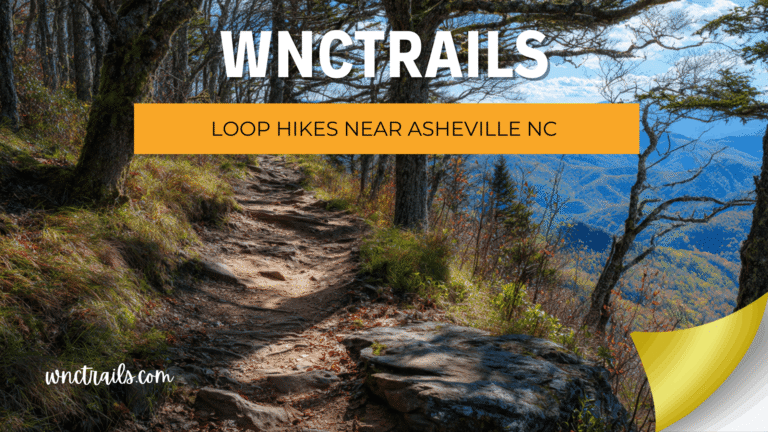
These trails are organized by foliage viewing angle — from high-elevation balds looking down across a colored canopy to mid-elevation forest immersion trails where you’re surrounded by color on every side. Both experiences are distinct and worth planning for separately.
1. Black Balsam Knob — Earliest Peak, Looking Down Into Color
Distance: 3.5 miles RT | Summit Elevation: 6,214 ft | Foliage View Type: Looking DOWN — colored forest below open bald | Typical Peak Window: October 1–12 | Crowd Index: Moderate | BRP Access Required: Yes
Black Balsam Knob is WNC’s earliest significant fall foliage destination because the forests that produce the color are below the 6,000-ft bald summit, not at it. Standing on the open bald, you look down onto the full Southern Appalachian high-country canopy at 4,500–5,500 ft turning color — yellows and oranges spreading across the ridges below you while the bald itself stays its late-season brown-green. This is the “looking down at a colored carpet” experience rather than the “surrounded by color” experience, and it peaks earlier than any other accessible viewpoint near Asheville — typically October 1–12.
Color at this viewpoint: Yellow birch (gold), mountain ash (orange-red), and scattered red maple (red-scarlet) dominate the upper forest below the bald. Sugar maple at 4,000–4,500 ft contributes the strongest orange-red to the panorama as seen from above.
Crowd reality: Black Balsam Knob gets meaningful but manageable fall crowds — a fraction of Max Patch on comparable weekends because the trailhead is less prominently marketed. Arrive by 8 AM on peak weekends to secure the small BRP parking area.
BRP access note: Check parkway status before driving up — early October storms occasionally cause temporary BRP closures. The parkway is generally open during the foliage window but verify before departure.
2. Max Patch — Mid-October Peak, 360° Colored Ridge Panorama
Distance: 1.4 miles RT | Summit Elevation: 4,629 ft | Foliage View Type: 360° panorama across colored ridges | Typical Peak Window: October 8–18 | Crowd Index: High (peak fall = highest of year) | BRP Access Required: No (USFS road)
Max Patch at peak fall foliage is the most photographed hiking image in Western North Carolina — the open bald summit looking out over ridge after ridge of peak-color forest in every direction, a full 360° panorama of orange, red, and yellow rolling to every horizon. The experience is legitimate and earns its reputation. The crowd reality at peak is equally genuine: the trailhead is the most contested parking situation in WNC hiking during the October 10–20 window, with timed reservation systems, 5 AM trailhead arrivals by serious foliage photographers, and trail traffic that reduces solitude to near zero on weekend peak days.
Color at this viewpoint: From the summit, you’re looking at the 3,500–4,500 ft forest band, which produces the highest species diversity in the color palette — sugar maple (orange-red), red maple (scarlet), yellow birch (gold), tulip poplar (yellow), and sourwood (burgundy) all contribute. Peak color here is typically the most saturated display in WNC when conditions are right.
Crowd reality: USFS timed reservation system applies on peak fall weekends — book at recreation.gov. Without a reservation, arrive before 5:30 AM or accept roadside shoulder parking with a 0.5–1.0 mile walk-in. Weekday visits October 10–20 are dramatically less crowded and logistically simpler. The hike itself doesn’t change — the experience does.
3. Graveyard Fields — High Valley in Peak Color
Distance: 3.2 miles RT | Elevation: 5,100–5,500 ft | Foliage View Type: Open mountain valley — immersed in color on valley walls | Typical Peak Window: October 5–15 | Crowd Index: High | BRP Access Required: Yes
Graveyard Fields in peak fall color offers a view type absent from both the open balds and the forested trails — you’re standing in an open mountain valley bowl at 5,100 ft while the surrounding Pisgah ridge walls are colored from base to rim. The Yellowstone Prong runs through the valley floor and reflects the canopy color on calm mornings. The valley’s open aspect means you see the color on the slopes around you rather than just overhead or far below — a middle-distance, surrounding-color experience specific to high-elevation mountain bowls. Upper and Lower Falls add vertical movement to the composition.
Color at this viewpoint: The valley walls at 5,100–5,500 ft turn primarily yellow birch (gold), red maple (red), and mountain ash (orange-red) in the first two weeks of October. The open meadow floor greens are still visible, creating a green-valley-with-colored-walls composition specific to this site.
Crowd reality: Graveyard Fields is one of the most crowded BRP stops during peak fall — arrive before 8:30 AM on weekends. The lot fills by 9:30 AM and shoulder parking along the BRP is limited. Fall weekday visits are substantially less congested.
4. Craggy Pinnacle — Black Mountains in Color, Asheville Valley Below
Distance: 1.4 miles RT | Summit Elevation: 5,892 ft | Foliage View Type: Colored ridgeline (Black Mountains) + valley floor below in early color | Typical Peak Window: October 5–15 (at elevation); valley color visible late October | Crowd Index: Moderate | BRP Access Required: Yes
Craggy Pinnacle provides a unique dual-elevation foliage view — the Black Mountain crest to the northeast turns first (5,500–6,684 ft, peaking October 1–10), and as that peak fades, the Asheville valley floor 4,000 ft below begins its own color cycle (peaking late October). A mid-October visit from Craggy Pinnacle catches the transitional window: the Black Mountains still holding late-peak color above while the valley below is in early-to-mid color. This two-elevation color layering is visible from nowhere else near Asheville with this clarity.
Color at this viewpoint: Black Mountain crest color is dominated by yellow birch, red maple, and mountain ash. The Asheville valley visible below shows tulip poplar (yellow), red maple (red), and oak (bronze-orange) in the late October window.
Crowd reality: Less crowded than Max Patch and Graveyard Fields on comparable peak weekends — the trailhead lot holds approximately 30 vehicles and is typically accessible until later in the morning. Good alternative to Max Patch when reservation system is active.
5. Rough Ridge — Grandfather Mountain Backdrop Against Colored Linville Gorge
Distance: 1.6 miles RT | Elevation: 3,700–4,100 ft | Foliage View Type: Rock outcrop — colored Linville Gorge below, Grandfather Mountain above | Typical Peak Window: October 10–20 | Crowd Index: Moderate | BRP Access Required: Yes
Rough Ridge at peak fall color produces one of the most compositionally distinctive foliage views in WNC — from the east-facing quartzite outcrops, you look directly at Grandfather Mountain’s distinctive profile above a fully colored Linville Gorge wilderness below. The middle ground is 4,000+ acres of unbroken deciduous forest in peak color; the upper left corner of the composition is Grandfather’s rocky crest. No other accessible viewpoint near Asheville provides this specific foreground-midground-landmark composition. This is a photography-specific recommendation for hikers who want a different foliage image than the Max Patch panorama.
Color at this viewpoint: Linville Gorge forest at 3,500–4,000 ft turns primarily red maple (scarlet), sugar maple (orange), and oak (bronze-copper) in mid-October. The color palette here is warmer and more red-orange than the yellow-dominated high elevations.
Crowd reality: Rough Ridge is undervisited relative to its visual quality — the scramble approach and lower profile keep it off most foliage tour itineraries. October weekday visits approach solitude even at peak. Wet-rock hazard: the quartzite outcrops are dangerously slippery in rain — plan only dry-day visits.
6. Lover’s Leap (Hot Springs) — Colored River Gorge From Above
Distance: 3.2 miles RT | Elevation: 1,300–2,100 ft | Foliage View Type: Looking DOWN into colored French Broad River gorge | Typical Peak Window: October 15–28 | Crowd Index: Low | BRP Access Required: No
Lover’s Leap is WNC’s best fall foliage gorge-view hike at lower elevation — the ridge above Hot Springs looks down into the French Broad River corridor at exactly the right time (late October) when the lower-elevation deciduous species are at their peak. At 1,300–2,100 ft, this trail catches the color of tulip poplar, sycamore, red maple, and oak in the gorge walls below — species that turn later and warmer (orange-yellow-red) than the cool-toned yellows of the high-elevation yellow birch. The gorge concentration effect — color on both walls and the valley floor simultaneously — makes this a rich immersive experience rather than a wide panorama.
Color at this viewpoint: Lower elevation species dominate — tulip poplar (clear yellow), red maple (red-orange), sugar maple (orange), sycamore (yellow-brown), and oak (bronze-copper) in the October 15–28 window. The river surface reflects the gorge walls on calm mornings.
Crowd reality: Hot Springs is off the standard foliage tour route. This trail during WNC’s peak foliage weekend has a fraction of the traffic of Max Patch. A genuine low-crowd foliage hike with legitimate views. BRP-independent access via NC-25.
7. Bearwallow Mountain — Pastoral Valley in Color
Distance: 4.2 miles RT | Elevation: 2,200–3,900 ft | Foliage View Type: Colored pastoral valley below + ridge color surrounding summit | Typical Peak Window: October 12–22 | Crowd Index: Low | BRP Access Required: No
Bearwallow Mountain in fall delivers a foliage experience specific to its unusual position between mountain wilderness and agricultural valley — the Cane Creek farmland below turns color later than the forest above, producing a transitional valley-and-ridge color composition visible from the east-facing summit meadow in mid-October. The working farmscape patchwork in fall color is a pastoral foliage image that doesn’t exist at any of WNC’s wilderness-facing viewpoints. The approach forest through mixed hardwood adds immersive trail-level color on the ascent. No BRP dependency, no reservation system, low fall traffic.
Color at this viewpoint: Summit ridge and approach forest: sugar maple (orange-red), red maple (scarlet), yellow birch (gold). Valley floor visible below: tulip poplar (yellow), red maple (orange-red), pasture oak (bronze). The combination of mountain forest color above and agricultural valley color below is Bearwallow’s signature fall composition.
Crowd reality: Consistently one of the best low-crowd fall foliage hike values near Asheville. The 1,000 ft of elevation gain deters casual visitors; the county road access and lack of BRP marketing keeps it off most tourist itineraries.
8. Art Loeb Trail (Black Balsam to Sam Knob) — Full Immersion Foliage Ridge Walk
Distance: 5.0–6.0 miles RT (various configurations) | Elevation: 5,800–6,214 ft | Foliage View Type: Continuous ridge walk with colored forest below on both sides | Typical Peak Window: October 1–12 | Crowd Index: Moderate | BRP Access Required: Yes
The Art Loeb Trail ridge walk from the Black Balsam trailhead through Sam Knob and Tennent Mountain offers the most sustained fall foliage ridge experience accessible from Asheville — 5+ miles of open-bald and heath-covered ridgeline with colored forest in the valleys on both sides for the entire route. Where Max Patch gives you a single summit viewpoint, this corridor gives you a continuous elevated-ridge perspective on the surrounding color for hours. The southern Pisgah high country in the first week of October, seen from above while the forest below transitions, is the most immersive single-day foliage experience in the region.
Color at this viewpoint: The full spectrum of high-elevation fall color — yellow birch (gold), red maple (red), mountain ash (orange-red), and the characteristic golden floor of the grassy balds transitioning to brown. Looking east toward the Shining Rock Wilderness: unbroken forest turning in the drainages below the ridge.
Crowd reality: This corridor is less known than Max Patch and receives a fraction of the foliage weekend traffic. The 5+ mile commitment filters casual visitors. Accessible from the same general trailhead area as Black Balsam Knob — arrive by 8 AM on peak weekends for parking.
Fall Foliage Hike Quick Reference
| Trail | View Type | Peak Window | Elevation | BRP Needed | Crowd Index |
|---|---|---|---|---|---|
| Black Balsam Knob | Looking down into color | Oct 1–12 | 6,214 ft summit | Yes | Moderate |
| Max Patch | 360° panorama across ridges | Oct 8–18 | 4,629 ft summit | No | High |
| Graveyard Fields | Valley bowl — color on walls | Oct 5–15 | 5,100–5,500 ft | Yes | High |
| Craggy Pinnacle | Ridgeline + valley below | Oct 5–15 (upper); late Oct (valley) | 5,892 ft summit | Yes | Moderate |
| Rough Ridge | Gorge + Grandfather Mtn backdrop | Oct 10–20 | 3,700–4,100 ft | Yes | Moderate |
| Lover’s Leap | Looking down into colored gorge | Oct 15–28 | 1,300–2,100 ft | No | Low |
| Bearwallow Mountain | Pastoral valley + ridge color | Oct 12–22 | 2,200–3,900 ft | No | Low |
| Art Loeb Ridge (Black Balsam–Sam Knob) | Continuous ridge walk above color | Oct 1–12 | 5,800–6,214 ft | Yes | Moderate |
WNC Fall Foliage Elevation Calendar: Which Week to Target Which Elevation
The single most important piece of fall foliage planning information for WNC: peak color moves down the mountains at approximately 300–500 vertical feet per day as cold air descends with the season. High-elevation balds in early October and Asheville valley color in late October are the same season, separated by three weeks and 4,000 feet of elevation.
Fall Foliage Peak Windows by Elevation Band — Typical Year
| Elevation Band | Typical Peak Window | Dominant Color Species | Primary Color Palette | Representative Trails |
|---|---|---|---|---|
| Above 5,500 ft | September 28–October 10 | Yellow birch, mountain ash, red maple | Gold, orange-red, scarlet | Black Balsam, Graveyard Fields upper, Art Loeb high ridge |
| 4,500–5,500 ft | October 5–15 | Sugar maple, red maple, yellow birch, beech | Orange, scarlet, gold, bronze | Max Patch, Craggy Pinnacle, Graveyard Fields valley |
| 3,500–4,500 ft | October 10–20 | Sugar maple, red maple, sassafras, sourwood | Deep orange, red, burgundy | Rough Ridge, Looking Glass Rock, upper Bearwallow |
| 2,500–3,500 ft | October 15–25 | Red maple, tulip poplar, beech, oak | Red-orange, yellow, bronze-copper | Lower Bearwallow, Rich Mountain, mid-elevation AT sections |
| Below 2,500 ft | October 20–November 5 | Tulip poplar, oak, sycamore, red maple | Yellow, bronze, rust, copper | Lover’s Leap, valley greenways, French Broad River corridor |
Year-to-Year Variation: Why Calendar Dates Fail
The windows above shift up to two weeks earlier or later depending on three variables:
- Summer drought stress: Significant drought causes early, muted color that peaks and drops faster than normal. Drought-stressed trees often produce brown-yellow color rather than the saturated orange-red of a well-watered year. The color still comes, but it’s less vivid and shorter-lived.
- September–October nighttime lows: Cold nights (below 45°F) trigger anthocyanin production — the pigment that produces red and orange color. Years with consistently cold September nights produce more saturated red color than warm, slow-cooling falls. A warm September that delays the first cold nights can push the entire color season 1–2 weeks later.
- Early cold snaps vs. gradual cooling: An abrupt freeze after warm fall temperatures can cause leaves to drop before color develops fully — the worst foliage scenario. Gradual, consistent cooling from late September through October produces the best color development and longest peak window.
This is why WNC Trails reports current-season foliage stage rather than calendar-based predictions. Check the conditions tab in the first week of October — we’ll tell you which elevation band is at peak right now, not what historically peaks when.
WNC Foliage Tree Species Color Reference
| Tree Species | Color Produced | Primary Elevation | Relative Peak Timing |
|---|---|---|---|
| Sugar Maple | Orange to red-orange | 3,000–5,000 ft | Mid-October at mid-elevation |
| Red Maple | Scarlet to red | All elevations | Earliest to turn; often first red visible |
| Yellow Birch | Clear gold | 4,000–6,000 ft | Early October at high elevation |
| American Beech | Bronze to golden-tan | 3,000–5,500 ft | Mid-to-late October; holds leaves into November |
| Tulip Poplar | Clear yellow | 1,500–3,500 ft | Late October in valleys |
| Sourwood | Deep burgundy-red | 2,000–4,000 ft | Early-mid October; one of the deepest reds in WNC |
| Sassafras | Orange to orange-red | 2,000–4,000 ft | Mid-October at mid-elevation |
| Mountain Ash | Orange-red with red berry clusters | 4,500–6,000 ft | Early October at high elevation |
| Oak species | Bronze to copper-rust | All elevations | Turns late; extends color into November |
Two Foliage Viewing Angles: Looking Down Into Color vs. Being Surrounded by It
The type of fall foliage experience you’re planning determines which trail to choose. These are two fundamentally different visual experiences — many hikers default to summit hikes without realizing they’re choosing one over the other.
Looking Down Into Color: The Summit Bald Perspective
From an open bald or rock outcrop above the treeline, you’re looking at the colored canopy from above — a carpet or mosaic of color spread across the ridges and valleys below you. The experience is panoramic and painterly. Individual trees are indistinct; what you see is the aggregate color of entire forest stands. The color is far away, visually compressed by distance. Weather and light conditions dominate the experience — a hazy day washes out the panorama; a post-frontal clear day reveals color to every horizon.
Best trails for this experience: Max Patch, Black Balsam Knob, Craggy Pinnacle, Waterrock Knob, Rough Ridge. Summit or rock outcrop position required. Plan for clear weather.
Being Surrounded by Color: The Forest Immersion Perspective
On a forested trail in the 2,500–4,000 ft elevation band during peak color, you walk through the color rather than above it. Trees are close on both sides — individual leaves, branch structures, filtered light through the canopy. The experience is intimate rather than panoramic. Color overhead, at eye level, and underfoot as fallen leaves accumulate on the trail. The texture of bark and branch against vivid foliage is visible at arm’s length. This experience is equally spectacular in overcast conditions — the diffuse light of a cloudy day can saturate forest color more than direct midday sun.
Best trails for this experience: Rich Mountain Loop, Looking Glass Rock approach, Art Loeb Trail mid-elevation sections, lower Bearwallow Mountain, Lover’s Leap forest sections. Forested mid-elevation trail required. Works in any weather condition.
The Complete Fall Foliage Day: Combining Both
The most complete WNC fall foliage day combines both experiences — a morning summit hike for the panoramic above-color view, then an afternoon mid-elevation forest trail for the immersive close-color experience. The elevation difference means these two experiences can be at different color stages on the same day, amplifying the value of combining them. Example: Black Balsam summit (early October, looking down at peak color below) in the morning + Looking Glass Rock approach trail (mid-elevation forest immersion, same color stage) in the afternoon.
Fall Foliage Crowd Strategy: Peak Weekend Alternatives and Off-Peak Windows
Columbus Day weekend (second weekend of October) is the single busiest hiking weekend of the year in WNC — hotel rates in Asheville peak, Blue Ridge Parkway traffic backs up for miles, and the most popular trailheads are functionally inaccessible without a reservation or a 4 AM arrival. Understanding the crowd pattern opens up alternatives that produce equivalent experiences with a fraction of the logistics.
The Peak Weekend Reality
The second and third weekends of October (typically October 12–13 and October 19–20 in an average year) concentrate the majority of fall foliage tourism in WNC. During these four days, Max Patch requires a timed reservation that books out weeks in advance, the Blue Ridge Parkway in the Asheville corridor can have 30-minute traffic delays at popular pullouts, and Graveyard Fields begins filling before 8 AM.
Three Crowd Strategies That Work
Strategy 1 — Different Elevation, Same Quality: When the 4,500–5,000 ft elevation band is at peak and drawing maximum crowds (October 8–15), the 3,000–4,000 ft band is in early-to-mid color with dramatically lower traffic. Rough Ridge and Bearwallow Mountain offer legitimate foliage views with low crowds during the same weekend that Max Patch is at capacity. The color is slightly earlier-stage but still excellent — and you’ll have the trail to yourself.
Strategy 2 — Weekday Over Weekend: The WNC fall foliage weekday vs. weekend differential is the most dramatic of any hiking season. Tuesday through Thursday in October, even at peak color windows, has trailhead conditions that are simply a different experience than Saturday — 50–70% lower traffic at most BRP destinations, no reservation requirements, no shoulder parking situations. If any flexibility in your schedule exists, a Tuesday foliage hike is categorically better than a Saturday foliage hike at the same trail.
Strategy 3 — Late October at Low Elevation: The third week of October through the first week of November, the lower-elevation forest (below 2,500 ft) is in peak or near-peak color and is almost entirely overlooked by the visitors who came for the high-bald panoramas. The Lover’s Leap gorge in late October, the French Broad River corridor, and the Cane Creek valley visible from Bearwallow all offer legitimate foliage experiences with low competition at the exact time crowds are thinning from the high-elevation destinations. The color palette is different — warmer, more yellow-orange — but it’s genuinely at peak.
Fall Foliage Crowd Pattern by Weekend
| Weekend | Typical Date Range | Best Elevation Target | Crowd Level | Best Strategy |
|---|---|---|---|---|
| Early October | Oct 4–6 | Above 5,000 ft | Moderate | Black Balsam, Art Loeb Ridge — early access, moderate crowds |
| Columbus Day Weekend | Oct 11–13 | 4,500–5,500 ft (peak) | Very High | Weekday only, reservation required, or mid-elevation alternative |
| Mid-October | Oct 18–20 | 3,500–4,500 ft | High | Rough Ridge, Bearwallow — good color, lower traffic |
| Late October | Oct 25–27 | Below 3,000 ft | Moderate | Lover’s Leap, valley trails — late-season color, easy access |
| Early November | Nov 1–3 | Below 2,500 ft | Low | River and valley trails — final color, near-solitude |
Key Considerations
- Timing Your Visit: Peak color varies by elevation and year. Higher elevations (above 5,000 feet) typically peak in early to mid-October, while lower elevations (below 3,000 feet) may not peak until late October. Local resources like the Romantic Asheville Fall Color Forecast offer weekly updates.
- Trail Crowds: Fall is the busiest hiking season. Arrive early in the day or visit on weekdays to avoid crowded trailheads and parking lots, especially on the Blue Ridge Parkway.
- Weather Preparedness: Mountain weather changes quickly in autumn. Bring layers for warmth, rain protection, and sturdy footwear. Morning fog is common but often gives way to clear afternoons.
- Leave No Trace: Stay on marked trails, pack out trash, and respect fragile ecosystems. Fall brings more visitors, so responsible recreation helps preserve these special places.
- Accessibility: Some trails, like Craggy Pinnacle and Graveyard Fields, have paved or gravel sections suitable for a range of abilities, but always check current trail conditions before heading out.
Common Use Cases
- Scenic Photography: Sunrise and sunset hikes on open balds like Black Balsam Knob provide dramatic lighting for leaf photography. Waterfall hikes in DuPont State Forest contrast colorful leaves against rushing water.
- Family-Friendly Outings: Graveyard Fields and the Craggy Gardens Picnic Area offer relatively short, gentle hikes with rewarding views. These are suitable for families with children or mixed-ability groups.
- Challenging Treks: For experienced hikers, linking multiple summits or taking longer routes on the Mountains-to-Sea Trail delivers solitude and diverse scenery, especially in Pisgah National Forest.
- Leaf Peeping Drives: Combine short hikes with scenic drives along the Blue Ridge Parkway, stopping at overlooks and trailheads to maximize fall color experiences in a single day.
- Wildlife Observation: Autumn is an active time for wildlife. Early morning or late afternoon hikes may reveal deer, migrating birds, or even black bears preparing for winter.
Plan Your Fall Foliage Hike Near Asheville
WNC Trails updates foliage stage by elevation band, color quality ratings, and peak-window forecasts in real time through October and into November. Before any fall foliage hike — especially if you’re timing around a specific peak window — check the conditions tab for current elevation-band status rather than relying on a calendar date.
Frequently Asked Questions
- When is the best time for fall foliage hikes near Asheville NC?
Peak color typically occurs from early to late October, depending on elevation. Check local fall color reports for the most accurate timing. - Are dogs allowed on fall foliage trails?
Most trails in Pisgah National Forest, DuPont State Forest, and along the Blue Ridge Parkway allow leashed dogs. Always check specific trail regulations before visiting. - Is there an entrance fee for these hikes?
Most public land trails near Asheville are free to access. Some areas, like state parks, may charge parking fees”verify details before your trip. - How do I avoid crowds during leaf season?
Visit early in the morning, on weekdays, or explore lesser-known trails. Popular spots fill up quickly during peak weekends. - What should I bring on a fall foliage hike?
Dress in layers, carry water, snacks, a trail map, and a camera. Weather can change rapidly, so pack a rain jacket and extra warm clothing.
For more trail suggestions, seasonal updates, and detailed guides, explore the rest of WNC Trails and plan your next autumn adventure near Asheville.
Continue Exploring These Trails
- Hidden Hikes Near Asheville Nc
- Beginner Hikes Near Asheville Nc
- Blue Ridge Parkway Hikes
- Pisgah National Forest Hikes