Trail status (checked September 2026) — conditions change; confirm with the managing agency before you go.
- The Catawba Falls loop reopened after Hurricane Helene, but the upper viewing platform and the Wildflower Trail were still closed for repairs. Source: U.S. Forest Service
Pisgah National Forest has a lot of trails that promise a view, a summit, or a ridge line — but if a waterfall is the actual point of your hike, the list narrows fast. Not every trail in this forest passes a falls, and we’re not going to stretch the definition to pad a page. This guide sticks to the trails in our verified cluster that genuinely deliver on the waterfall angle, whether that means a five-minute walk to an overlook or a longer approach to a two-tiered cascade. We’ll also flag a couple of nearby trails worth pairing with a falls visit if you’re already in the area and want to make a full day of it.
The Waterfall Hikes That Actually Deliver
1. Looking Glass Falls
This is the one almost everyone pictures when they think of waterfalls in this part of the forest, and for good reason — it’s one of the most photographed waterfalls in the eastern US. The draw here isn’t a long trail; it’s an accessible overlook that lets you see the falls without a strenuous approach. If you’re short on time, traveling with people who can’t handle steep terrain, or just want a reliable payoff without route-finding, this is the stop that checks the box. It’s also a good one to hit early or late in the day, since the overlook nature of the spot means it draws crowds fast once the parking area fills.
2. Catawba Falls Trail (loop) — 3.5 mi loop, Easy to intermediate
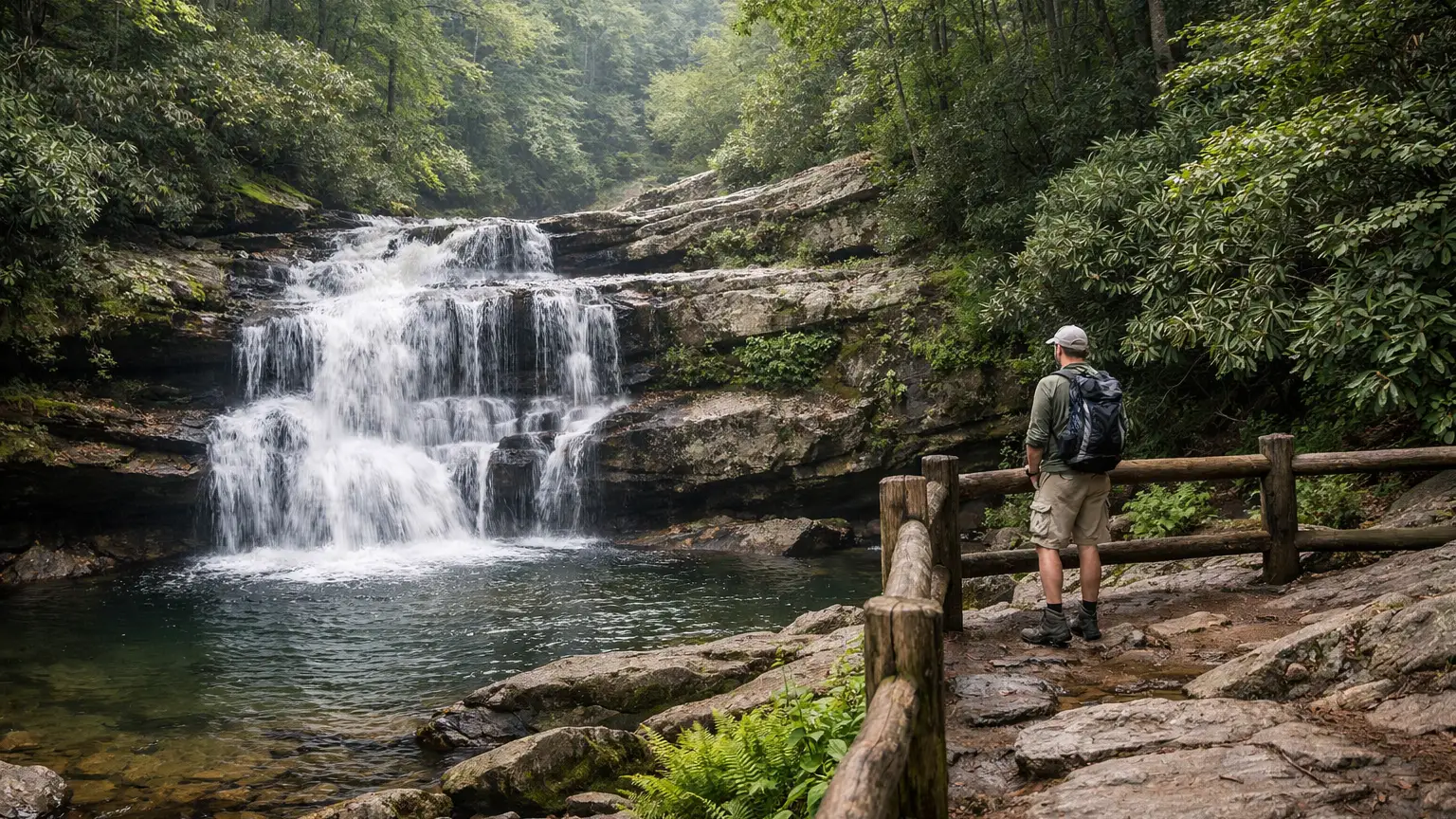
This is the pick for hikers who want an actual trail experience with a waterfall payoff, not just a roadside stop. The loop takes you to a 205-foot lower falls and an 80-foot upper falls, which gives you two distinct waterfall experiences on one outing. The lower falls area is more heavily trafficked and easier underfoot; the push up to the upper falls adds more effort and rewards you with a quieter, less crowded cascade. If you only have time for one “real hike to a waterfall” in this cluster, this is it — the loop length is manageable for most fitness levels, and the difficulty rating reflects a trail that’s approachable without being flat and boring.
3. Slick Rock Falls Trail — 0.99 mi, Moderate
Short mileage, moderate difficulty, one waterfall — this trail doesn’t try to be anything more than what it is. At just under a mile, it’s a reasonable add-on if you’re already exploring the area and want another falls without committing to a half-day hike. The moderate rating means it’s not a flat stroll, so don’t treat it as a casual after-dinner walk, but it’s short enough to fit into a morning alongside another trail on this list.
How We Ranked These
We didn’t rank this list by drama or Instagram appeal alone. Three criteria drove the order and inclusion:
- Verified waterfall feature. We only included trails where the waterfall is the documented, named feature of the hike — not trails that happen to cross a stream or pass a bridge. This kept trails like Pink Beds Loop, which has stream bridges but no documented waterfall feature, off this specific list even though it’s a fine hike in its own right.
- Accessibility relative to effort. We weighed how much trail work you have to put in versus what you get back. Looking Glass Falls scores high here because the payoff-to-effort ratio is about as good as it gets in this forest. Catawba Falls earns its spot because the extra effort to reach the upper falls is worth it, not just a mileage padding.
- Realistic crowd and condition expectations. A hike can have a great waterfall and still be a bad recommendation if the parking situation or trail condition makes it miserable most of the year. We factored in what we know about how these specific trailheads behave.
Parking and Trailhead Reality
Looking Glass Falls is the trailhead most likely to test your patience. Because it’s an overlook rather than a hike, people stop for five minutes and leave, which sounds like it should keep turnover high — but on weekends and during peak season, the small pull-off area fills quickly and stays full most of the day. If you’re aiming for this one, earlier arrival genuinely helps, and having a backup plan (like circling back later or hitting Catawba Falls first) isn’t a bad strategy.
Catawba Falls has a dedicated trailhead area, but it’s also become one of the more popular short hikes in this part of the forest, so don’t assume you’ll have the lot to yourself on a nice weekend. Slick Rock Falls, being shorter and less publicized, tends to see lighter trailhead traffic, which makes it a reasonable option if the other two are packed when you arrive.
None of these trailheads have guaranteed overflow parking, and access roads in this forest can be gravel or narrow in sections, so give yourself a buffer if you’re arriving during a busy weekend or leaf season. Check current conditions before you go, especially if recent weather has affected forest roads.
Seasonal Notes
Waterfall volume in this region tends to peak after periods of rain, which usually means late winter through spring shows these falls at their most dramatic. Summer can bring lower water flow depending on conditions, and fall brings the added complication of leaf-season crowds stacking on top of already-popular spots like Looking Glass Falls. If your goal is photos of the falls at full flow with fewer people around, aim for a weekday visit outside of the fall color rush. Winter can be beautiful at these falls too, but trail surfaces near water can ice over, so footing deserves extra attention on Catawba Falls and Slick Rock Falls in cold months. Always check current conditions before heading out, since forest road and trail status can shift with weather.
What to Bring
For Looking Glass Falls, you genuinely don’t need much beyond decent shoes, since it’s an overlook rather than a backcountry trail. For Catawba Falls and Slick Rock Falls, treat them like real hikes: sturdy footwear with grip, since the ground near waterfalls is routinely wet and can be slick even when it hasn’t rained recently. Bring more water than you think you’ll need for Catawba Falls given the loop’s length, and consider trekking poles if you’re not confident on uneven, sometimes muddy terrain near the falls themselves. None of these three require permits, but if you’re pairing a waterfall stop with a longer hike elsewhere in this forest, double check whether that trail has its own access requirements before you commit to a full-day plan.
Frequently Asked Questions
Which Pisgah waterfall hike is best for families with young kids?
Looking Glass Falls is the easiest option since it’s an accessible overlook rather than a trail requiring sustained hiking. Catawba Falls can work for families comfortable with a 3.5-mile loop, but the push to the upper falls adds more effort than very young kids may want to handle.
Can I see more than one waterfall in a single day?
Yes — all three trails on this list are reasonably grouped for a single day if you’re willing to drive between trailheads. A common approach is hitting Looking Glass Falls first since it takes minimal time, then doing the Catawba Falls loop, and adding Slick Rock Falls if you still have daylight and energy.
Are these waterfall trails busy year-round?
Looking Glass Falls sees consistent traffic nearly all year because of how accessible it is. Catawba Falls gets busier on weekends and during leaf season. Slick Rock Falls tends to stay quieter simply because it’s shorter and less widely known, though that can change during peak seasons.
Do any of these waterfall trails require a permit?
None of the three waterfall-specific trails in this cluster — Looking Glass Falls, Catawba Falls, or Slick Rock Falls — carry a permit requirement based on our verified data. If you’re combining a waterfall stop with a longer backcountry route elsewhere in the forest, check that trail’s specific requirements separately.
What’s the easiest waterfall hike if I have limited mobility?
Looking Glass Falls is the clear answer here, since it’s designed as an overlook rather than a hike requiring sustained walking on uneven terrain.
If you want to see every verified trail in this part of Pisgah National Forest — not just the waterfall hikes — browse the full WNC Trails directory at WNC Trails directory, where you can filter by difficulty, distance, and check current conditions before you head out.
Related Pages
- Shining Rock Wilderness Hikes
- Pisgah Hikes With Fishing Spots
- Waterfall Hikes Near Asheville NC
- Waterfall Hikes in North Carolina
- Trail Conditions Near Asheville NC
- Blue Ridge Parkway Waterfall Hikes
- Roadside Waterfalls in North Carolina
Want more routes in this area? See our complete guide to Pisgah National Forest hikes.